


INP-WealthPk
Global risks and Middle East conflict pose challenges to economic outlook
May 07, 2026
By Ayesha Saba
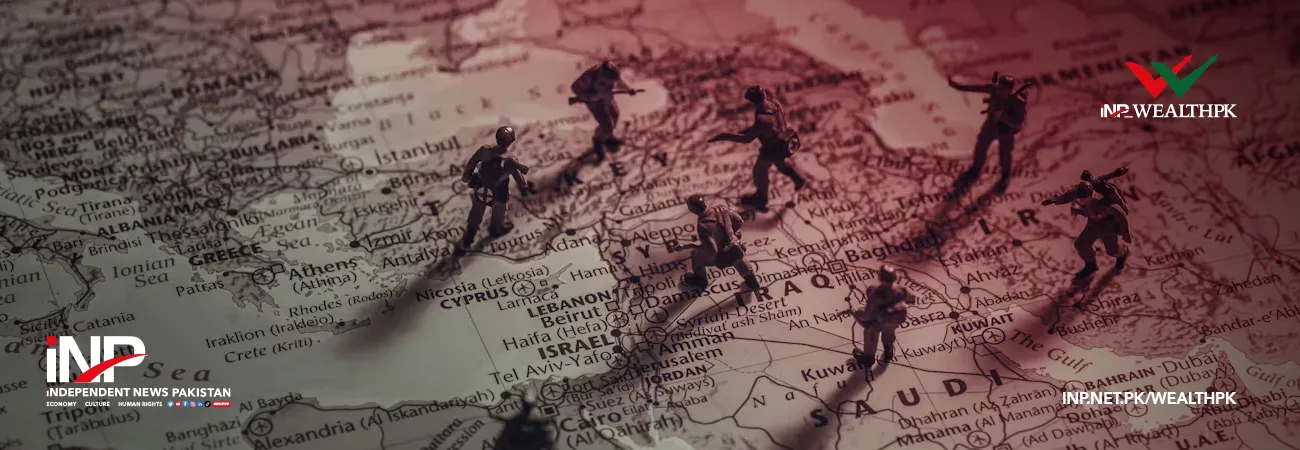
Rising global uncertainties and the ongoing Middle East conflict are emerging as key risks to Pakistan’s economic outlook, with potential implications for inflation, energy prices, and external stability.
According to the “Monthly Economic Update & Outlook April 2026” released by the Finance Division and available with Wealth Pakistan, geopolitical developments are adding to uncertainty in both the global and domestic economic environment.
The report highlights that the ongoing conflict in the Middle East has affected global markets by disrupting supply chains, influencing commodity prices, and weakening business confidence. These developments have introduced additional risks for economies dependent on energy imports.
The document notes that rising international oil prices are already being transmitted into domestic inflation, altering the baseline price situation. This reflects the sensitivity of domestic prices to global energy trends.
The global economic outlook also reflects emerging challenges. According to the report, global growth is projected to moderate to 3.1% in 2026 and 3.2% in 2027, compared to 3.4% recorded in 2025, indicating a slowdown in economic activity.
The report identifies multiple downside risks to global growth, including prolonged geopolitical conflicts, increasing fragmentation in global trade, and renewed trade tensions. These factors have the potential to weaken economic performance and disrupt financial markets.
Global economic indicators further reflect the impact of these developments. The J.P. Morgan Global Composite Purchasing Managers’ Output Index declined to 51.0 in March, down from 53.3 in February, indicating a slowdown in global business activity.
Business optimism also weakened, reaching a five-month low, while global employment recorded a slight decline for the first time in over a year. Major economies, including the United States, China, and the euro area, reported job losses during the period.
Inflationary pressures at the global level also increased. The report indicates that global headline inflation is expected to rise to 4.4% in 2026 before easing to 3.7% in 2027.
Commodity markets experienced significant volatility. The energy price index increased by 41.6%, driven by sharp rises in natural gas and crude oil prices. Fertilizer prices also increased by 26.2%, while non-energy commodities rose by 2.5%.
Food prices showed an upward trend as well. The FAO Food Price Index increased during March, reflecting higher prices for cereals, meat, dairy products, vegetable oils, and sugar.
The report highlights that disruptions in oil supply and price volatility continue to affect global markets, contributing to uncertainty in economic projections.
Despite these challenges, the document indicates that Pakistan’s economy is relatively better positioned compared to previous periods of external stress. Improved macroeconomic fundamentals and policy measures are expected to support economic stability.
The data suggests that while global risks remain elevated, their impact on Pakistan’s economy will depend on developments in energy markets, trade conditions, and geopolitical stability, as reflected in the official report.

Credit: INP-WealthPk
Related Articles