i NEWS PAK-CHINA
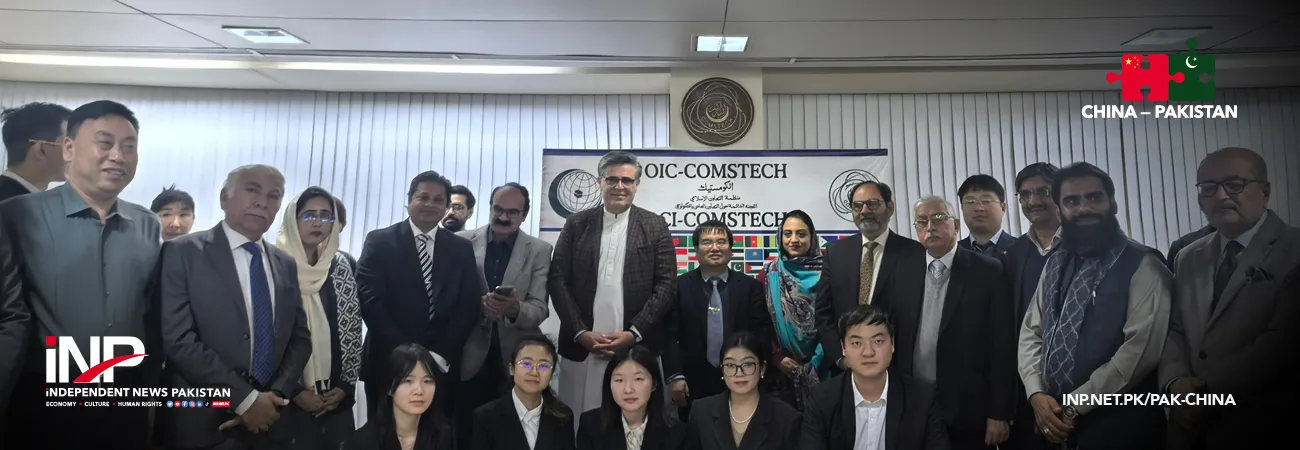
China-Pakistan Education symposium held marking new phase of cooperationBreaking
January 31, 2026
The first China-Pakistan Symposium on Education, Science and Industrial Cooperation was held on January 20, 2026, at COMSTECH headquarters in Islamabad, marking a renewed and more integrated approach to bilateral collaboration.
The meeting was chaired by Senior Professor Zhang Lixin of Northwest A&F University, Chairman of Silkroad Biohealth Agricultural Industry Alliance and Chief Scientist/Director of Shaanxi Belt and Road Joint Laboratory on Dryland Biological Resources and Green Smart Agriculture,China, and attended by Khalil Hashmi, Ambassador of Pakistan to China, who delivered the keynote address.
More than 50 representatives from government agencies, universities, research institutions, and leading enterprises from both countries participated.
In his opening remarks, Professor Zhang Lixin welcomed the diverse delegation, which included representatives from Shaanxi Province, Chinese national media, faculty and students from Northwest A&F University, as well as officials from Pakistan's science and technology authorities, universities, and industry.
Discussions focused on agriculture, higher education, and industrial cooperation. Representing Pakistan's Federal Ministry of Science and Technology, Shakil Arshad outlined ongoing collaborations in space science and Traditional Chinese Medicine with Chinese universities, including Nanjing University and Xi'an Jiaotong University, China Economic Net (CEN) reported on Saturday.
Agricultural experts emphasized the urgency of collaborative innovation. Professor Muhammad Azam Khan, former Director General of Pakistan's National Agriculture Research Center, noted that more than 700 crop varieties developed by the council now cover 80% of Pakistan's farmland.
He called for enhanced cooperation with China in precision agriculture, smart machinery, and sesame value-chain development.
Professor Shah Nawaz Marri, Chairman of Department of Plant Breeding and Genetics, Sindh Agriculture University, announced plans to establish Pakistan's first China-Pakistan Agricultural Cooperation Center and expressed hopes to conduct joint research with China in areas such as pepper variety improvement and the exchange of germplasm resources for high-value crops.
Business representatives outlined specific investment opportunities. Sun Lianfeng, General Manager of Baoji Haisheng Modern Agriculture, stated that the company plans to introduce high-density apple cultivation technologies to Pakistan, which could increase yields by 30% while reducing water usage by 80%. Feng Lianying, General Manager of Xianyang Kangda Modern Agriculture, confirmed that preparations are actively underway to invest in modern poultry farming facilities in Pakistan.
Educational cooperation has already yielded tangible results. More than 260 Pakistani students are currently enrolled in agriculture-related majors at Northwest A&F University, and over 510 participants have completed training programs.
Last year and this year, a total of 10 Chinese Silk Road graduate students have come to Pakistan University for exchange studies, while 2 Pakistani graduate students will go to China for training in smart agricultural technology.
In his closing remarks, Ambassador Khalil Hashmi described agriculture as a cornerstone of high-quality development under China-Pakistan Economic Corridor, emphasizing the strong complementarity between Pakistan's resources and China's technological strengths.
He also revealed that a major international cooperation program, approved in December 2025, will provide a new platform for future collaboration.
The symposium was followed by a ten-day series of visits by the Chinese delegation across Islamabad, Lahore and other regions.
Activities included participation in a Pakistan–China agriculture investment conference, site inspections of farms, food processing and poultry facilities, and meetings with research institutions such as the Pakistan Academy of Sciences and the Ayub Agricultural Research Institute. Several cooperation agreements were signed, and roadmaps were established for joint laboratories, technology transfer centers, and demonstration parks.
Together, the forum and follow-up visits transformed dialogue into practical cooperation, strengthening people-to-people ties and laying a solid foundation for a deeper China-Pakistan partnership as the two countries approach the 75th anniversary of diplomatic relations, CEN's report added.
Credit: Independent News Pakistan (INP) — Pak-China
Related News