


INP-WealthPk

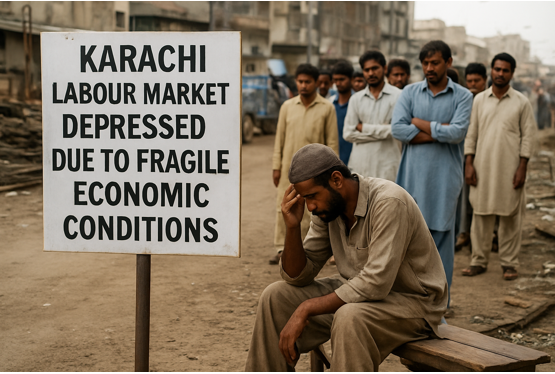
Karachi experiences pronounced downturn in labor market
December 03, 2025
Ahmed Khan Malik
Pakistan’s industrial hub – is experiencing a pronounced downturn in its labour market as fragile economic conditions continue to weigh heavily on businesses and workers alike.
The business and trading community reports weakened demand, reduced hiring, and rising uncertainty — factors that together are reshaping the city’s employment landscape.
Over the past several months, local traders’ associations and labour representatives have noted a steady contraction in job opportunities. Small and medium-sized enterprises (SMEs), which make up the backbone of Karachi’s economy, are particularly strained.

Zahid Hameed, Senior Vice-President of Korangi Association of Trade & Industry (KATI), cited elevated production costs, expensive borrowing, and sluggish consumer spending as key obstacles. He said several industrial zones were running at reduced capacity, resulting in fewer shifts and temporary layoffs.
He said that workers in the city’s sprawling informal sector — ranging from street vendors and transport operators to daily-wage labourers — are feeling the impact even more acutely. “Without formal contracts or social protections, they rely on day-to-day earnings that fluctuate sharply with economic activity,” Zahid said. He said that the income of laborers had dropped substantially, forcing them to take on multiple small jobs, borrow from informal lenders, or cut back on household necessities.
Mureed Ali Shah, a labour advocate, said that the weakened market is not only affecting employment rates but also eroding job quality. “As firms struggle to stay afloat, many are offering shorter-term contracts, reducing benefits, or delaying payments.” “Workers are willing to accept almost any terms just to keep working,” he said, noting that this trend risks entrenching exploitation and widening inequalities in the labour force.
He said that the city’s industrial sector — once a major engine of job creation — is under particular stress. “Textile units, garment factories, and leather processing facilities, which traditionally employ thousands of workers, have reported erratic order patterns from domestic buyers and international clients.” “Export-oriented businesses continue to grapple with high input prices and logistics challenges, making it difficult to stay competitive,” Mureed noted.
“Factory owners say that until economic stability is restored, large-scale hiring remains unlikely,” he said. The services sector, which includes retail, hospitality, education, and transportation, is also experiencing volatility. “Amid these pressures, young job-seekers — particularly recent graduates — are finding it increasingly difficult to enter the workforce,” Mureed said.
He said that career counselors have noted a rise in competition for entry-level roles, with employers favoring experienced workers who require less training. “This shift has left many first-time job-seekers discouraged and considering opportunities abroad.”
Despite the bleak outlook, economist Saim Ali believes the downturn can be reversed with targeted policy support and improved economic stability. He argued that easing the financial burden on SMEs, stabilizing input costs, and offering incentives for job creation could help revive employment. “Additionally, investment in vocational training and digital skills would enhance workforce resilience and help workers adapt to shifting market demands,” he added.
Credit: INP-WealthPk
Related Articles