


INP-WealthPk
Pakistan can turn its solar boom into industrial growth by learning from China's model
July 18, 2026
By Muhammad Zulqarnain
Pakistan's rapid adoption of solar energy is creating an opportunity to build a domestic clean-energy industry, but experts say achieving that requires a long-term strategy similar to China's integrated approach to renewable energy development.
Over the past five years, Pakistan has imported more than 50GW of solar panels, with an estimated 38GW already installed. Solar energy now accounts for about 28% of the country's electricity generation, compared with around 10% just two years ago.
While this consumer-led expansion has reduced reliance on expensive imported fuels and eased pressure on the national grid, Pakistan now faces the challenge of converting strong domestic demand into industrial growth. Experts say China's experience offers a practical roadmap for building an integrated renewable-energy ecosystem centred on local manufacturing, energy storage, grid modernisation, financing and industrial demand rather than relying primarily on imported equipment.
Speaking to Wealth Pakistan, Muhammad Sheraz Amir, Associate for Energy and Climate at Renewable First, said China's experience demonstrates that successful energy transitions are built on much more than consumer demand.
Through its 13th and 14th Five-Year Plans, the New Energy Vehicle (NEV) mandate and the 2017 Energy Storage Policy, China created a long-term framework that simultaneously supported manufacturing, deployment and technological innovation.
"China supplied the three ingredients any industrial take-off requires: a clear policy signal, a demand mandate and effective ecosystem facilitation," he said.
Manufacturing incentives, including a 13% VAT export rebate for solar modules and energy storage systems, enabled Chinese companies to scale production rapidly. Today, China accounts for more than 75% of global solar photovoltaic (PV) module manufacturing capacity.
Amir said Pakistan has already achieved one of those ingredients largely through market-driven adoption. The country's rapid shift towards rooftop solar has helped reduce fuel imports and demonstrated strong consumer demand for renewable energy.
However, he said Pakistan now requires a consistent industrial policy to convert that demand into long-term economic gains.
"The priority now is to localise the assembly of solar panels, inverters, batteries and other balance-of-system components," he said, adding that Pakistan must also invest in grid modernisation, energy storage integration and financing mechanisms to sustain future growth.
Echoing these views, Arfa Ijaz, Research Assistant at the Sustainable Development Policy Institute (SDPI), said China's vertically integrated manufacturing chain—from polysilicon production to finished solar modules—has given it a decisive cost advantage in the global renewable-energy market.
Over the past decade, she noted, the average cost of global wind and solar PV projects has fallen by about 60% and 80%, respectively, largely due to China's manufacturing scale and continuous technological improvements.
This competitiveness has supported unprecedented deployment. China installed a record 315GW of new solar capacity in 2025, raising its cumulative installed PV capacity to about 1,200GW and allowing renewable electricity generation to exceed thermal generation for the first time.
During the first quarter of 2025 alone, China added around 60GW of new solar capacity, with rooftop systems accounting for approximately 60% of the total.
Ijaz said China's expansion has been reinforced by continuous investment in transmission infrastructure connecting resource-rich western regions with major industrial and urban centres in the east. Energy storage mandates and expanding electric vehicle charging networks have also improved grid flexibility by absorbing intermittent renewable generation.
She added that China's successive Five-Year Plans have created a self-reinforcing cycle in which policy certainty encourages manufacturing investment, manufacturing lowers costs, and lower costs accelerate deployment.
In September 2025, China further raised its ambitions by setting a target of 3,600GW of installed wind and solar capacity by 2035—more than six times its 2020 target.
However, she cautioned that China's model also highlights the risks of rapid expansion without balanced market planning.
Excess manufacturing capacity pushed wholesale solar prices down by nearly 50% in 2023 and a further 25% in 2024. By 2025, five leading Chinese optoelectronics companies had accumulated combined losses exceeding 28.9 billion yuan (US$4.15 billion). Grid integration challenges have also intensified, with average full-load operating hours for large power plants declining by 312 hours in 2025.
"China's experience shows that scale matters, but planning matters even more," she said. "For Pakistan, the lesson is clear: demand alone is not enough. A successful energy transition requires long-term policy certainty, industrial coordination and sustained investment in supporting infrastructure."
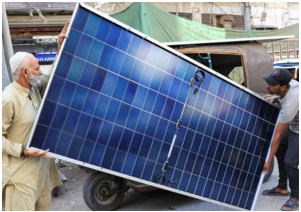
Credit: INP-WealthPk
Related Articles