

i INP-WEALTHPK
China’s anti-desertification model offers roadmap for restoring Pakistan’s degraded landsتازترین
May 18, 2026
By Azam Tariq
As desertification tightens its grip across South Asia, Pakistan faces a mounting environmental challenge, with nearly half of its land affected by degradation. Experts believe China’s success in reversing desertification through the Three-North Shelterbelt Program could offer Pakistan a practical roadmap for restoring arid landscapes and strengthening climate resilience.
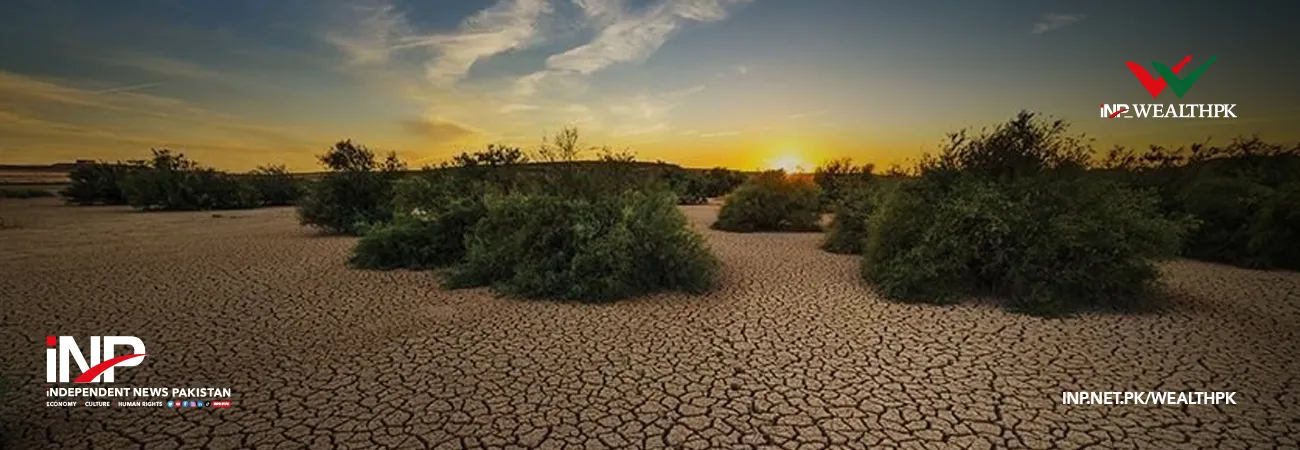
Pakistan’s battle against land degradation is reaching a critical stage. According to the Ministry of Climate Change and Environmental Coordination, a large portion of the country’s land is affected by deforestation, overgrazing, salinity and waterlogging, while more than 80 percent of Pakistan falls within arid and semi-arid zones.
Data submitted by Pakistan to the UN Convention to Combat Desertification shows that out of the country’s total 79.6 million hectares of land, nearly 62.4 million hectares are vulnerable to desertification.
The United Nations Development Programme estimates that 3.25 percent of Pakistan’s land area is already degraded, affecting more than 38 million people.
Major desert regions — including Thar in Sindh, Cholistan and Thal in Punjab, and Kharan in Balochistan — continue expanding due to wind erosion, rising soil salinity and uncontrolled grazing.
A 2024 study published in Environmental Development and Sustainability, based on satellite imagery from Bahawalpur division, found that desertified land expanded further in 2022 compared with 2021.
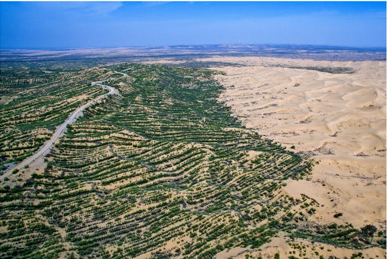
Against this backdrop, China’s experience presents a compelling model. Through its Three-North Shelterbelt Forest Program — regarded as the world’s largest afforestation initiative — China has brought 53 percent of its treatable degraded land under management and contributed nearly 25 percent of the world’s new green coverage.
Speaking with Wealth Pakistan, Masood Lohar, Founder and CEO of Clifton Urban Forest, described China’s desert rehabilitation efforts as “not only an example for Pakistan, but for the whole world.”
He noted that Pakistan’s diverse desert ecosystems — ranging from Cholistan and Thar to the highland deserts of Balochistan and Sindh — provide substantial opportunities to draw on Chinese expertise.
However, Lohar stressed that Pakistan’s climate adaptation strategy should not rely solely on desert restoration.
“Pakistan has perhaps one of the world’s largest wind corridors, stretching from the Thar desert through Karachi to Jiwani,” he said, adding that almost half of Sindh and large parts of Balochistan rank among the world’s leading wind corridors.
Combined with solar radiation potential of 5 to 7 kWh per square metre per day, these renewable energy resources could significantly reduce Pakistan’s dependence on hydrocarbons.
Yet Lohar cautioned that Pakistan’s main challenge lies in implementation rather than policy formulation.
“When it comes to translating these ideas on the ground, Pakistan is not a very good example,” he said, arguing that the country has struggled even on fertile irrigated lands.
Dr. Muhammad Faisal Ali, Assistant Professor specialising in Climate Change and Agriculture at the Pakistan Institute of Development Economics, proposed a structured framework for localising Chinese expertise in Pakistan.
Talking to Wealth Pakistan, he called for establishing technology testing laboratories and training hubs in Cholistan and Kharan, where provincial officials could learn modern sand-control and dryland management techniques.
“The focus of joint demonstration sites should be to establish them as technology testing hubs and training centres,” he said, stressing the importance of integrating research and data collection into every project.
He also proposed incorporating dryland management into the China-Pakistan Economic Corridor framework through a dedicated bilateral working group on desertification control.
Under the proposal, Chinese experts would train Pakistani officials, NGO workers and researchers through on-site programmes tailored to local conditions.
China has already demonstrated major progress in this area. In late 2024, it completed a 3,046-kilometre “green scarf” around the Taklamakan Desert. Its innovations — including straw checkerboard barriers, solar-powered smart irrigation and photovoltaic sand-control systems — have helped transform barren dunes into productive landscapes.
Beijing has also shared these technologies with Central Asian countries, where they reportedly helped triple cotton yields in parts of the Aral Sea region while reducing water consumption by more than 30 percent.
Dr. Faisal Ali stressed that Pakistani trainees must adapt imported knowledge to local environmental realities.
“Trainees should prepare technical manuals according to Pakistan’s environmental conditions,” he said, warning that relying solely on Chinese manuals without localisation could limit practical effectiveness.
On financing, he urged policymakers to prioritise desertification control through provincial development funds and international climate finance mechanisms, including the Green Climate Fund.
He identified rangeland restoration — through reseeding and controlled grazing — as one of the most effective entry points, noting that livestock remains central to desert livelihoods.
“When you focus on these areas, socio-economic conditions automatically improve. Pastoral incomes increase as well,” he said, adding that such models could later be expanded nationwide.
With China offering proven technologies and Pakistan facing growing ecological stress, experts believe the way forward lies in moving beyond policy discussions toward practical implementation. By integrating Chinese expertise through CPEC, strengthening local technical capacity, and linking restoration efforts with renewable energy and livelihood development, Pakistan could turn its desertification challenge into an opportunity for sustainable growth.
Credit: INP-WealthPk
متعلقہ خبریں