


INP-WealthPk

AI boom squeezes entry-level jobs but leaves wider workforce intact
August 25, 2026
By Ayesha Saba
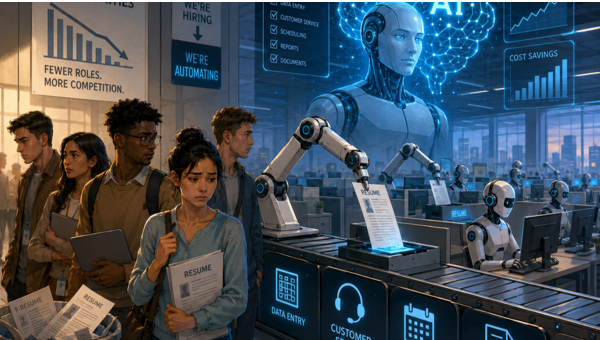
Artificial intelligence is beginning to squeeze entry-level employment in highly exposed occupations, but there is little evidence so far of mass job losses widely feared from the technology.
DataCamp's The State of AI Careers 2026, available with Wealth Pakistan, says generative AI is driving a structural reorganisation of the labour market rather than eliminating human work on a broad scale. Available evidence instead points to a reallocation of skills, shifts in wage premiums and particularly strong pressure on younger workers trying to enter AI-exposed professions.
The clearest disruption is emerging in the entry-level employment pipeline. Research based on continuous monthly payroll records covering more than 25 million workers found that employment among workers aged 22 to 25 in AI-exposed occupations, including software development, customer support and accounting, fell 6% between late 2022 and September 2025.
The decline becomes more significant when compared with the broader labour market. During the same period, overall employment expanded, while employment among older and more experienced workers in the same AI-exposed occupations increased by 6% to 9%.
Had employment among younger workers followed the prevailing growth trend, their numbers should have increased rather than declined. The gap between expected growth and the actual contraction translates into a 16% relative employment decline for workers aged 22 to 25 in AI-exposed fields, the report says.
However, this pressure on younger workers has not translated into widespread unemployment across occupations exposed to AI.
The report cites research tracking unemployment through the US Current Population Survey since late 2022, which found no systematic increase in joblessness among workers in the occupations most exposed to AI. It notes that an economic shock comparable to the 2007-09 recession would have been expected to push unemployment in the most exposed occupations from around 3% to 6%, but no such increase has occurred.
The findings suggest that the immediate employment effects of AI are more complex than simply replacing workers. The available evidence points instead to uneven pressure within occupations, with early-career workers facing greater disruption while older and more experienced workers in the same fields have so far remained comparatively resilient.
Longer-term employment projections also remain positive. The World Economic Forum estimates that structural transformation in the global labour market between 2025 and 2030 will affect the equivalent of 22% of existing jobs. Around 170 million new roles are projected to emerge globally by the end of the decade, while about 92 million existing roles could be displaced, producing a net increase of 78 million jobs.
US labour projections point in a similar direction. The Bureau of Labor Statistics expects total US employment to increase 3.1% from about 170 million in 2024 to 175.2 million in 2034.
While generative AI is expected to reduce labour demand in areas such as administrative support, design and retail sales, growing demand for AI-based systems, data processing and research services is projected to support employment growth of 7.5% in professional, scientific and technical services and 6.5% in the information sector.
The report cautions, however, that the eventual employment impact will depend heavily on the pace of AI advancement and the workforce's readiness to adapt to it.
It highlights four possible global labour-market scenarios for 2030. Under a "supercharged progress" scenario, rapid AI advancement accompanied by high workforce readiness would boost productivity as humans increasingly manage autonomous systems, while new jobs emerge quickly to replace those lost.
A slower technological trajectory combined with a well-prepared workforce could instead produce a "co-pilot economy" built around human-machine collaboration and stable, pragmatic growth.
The risks become considerably greater when workforce skills fail to keep pace with technology. Under the report's "age of displacement" scenario, rapid AI advancement combined with low workforce readiness could drive companies to automate roles to fill talent gaps. While keeping businesses competitive, this shift could trigger higher unemployment, weaker consumer confidence, and social disruption.
Slow AI development coupled with inadequate workforce readiness could meanwhile produce uneven productivity gains, widespread economic frustration and widening inequality under what the report describes as a "stalled progress" scenario.
The transition is already generating considerable anxiety among workers. Research based on data from 81,000 Claude users found that perceived job insecurity rises with observed AI exposure. For every 10% increase in exposure, defined as the share of a job's tasks completed using the model, an employee's perceived risk of job loss rises by 1.3%.
Workers in the highest quartile of exposure mention displacement concerns three times as frequently as those in the lowest quartile, while early-career professionals report greater anxiety than their more senior counterparts.
Yet the report concludes that the larger long-term concern may not be widespread redundancy. It argues that as gains from AI automation flow disproportionately to asset owners and technology providers, the more realistic long-term threat for the broader labour pool could be stagnant wage growth rather than irrelevance.
Overall, the findings suggest that AI is unlikely to produce a uniform employment shock. Its effects are emerging unevenly, with particularly visible pressure on the entry-level employment pipeline, while broader unemployment among highly exposed workers has so far remained relatively stable. Workforce readiness and the ability to adapt to AI will therefore be increasingly important in determining how workers fare as the technology develops.
Credit: INP-WealthPk
Related Articles