



INP-WealthPk

KSE-100 plunges 16,112 points in February as PSX posts steepest drop since March 2020
March 03, 2026
By Moaaz Manzoor
The Pakistan Stock Exchange (PSX) witnessed intense volatility in February 2026, as the benchmark KSE-100 Index plunged 16,112 points month-on-month to close at 168,062 points, registering a negative return of 8.7 percent — the steepest monthly decline since March 2020.
According to Arif Habib Limited (AHL), market sentiment remained weak throughout the month due to escalating geopolitical tensions, sustained foreign selling pressure, lower-than-expected corporate earnings, and concerns surrounding the Reko Diq project.
The month was marked by sharp intraday swings, including a historic single-day drop of nearly 7,000 points, reflecting heightened uncertainty among investors.
Trading activity also slowed compared to the previous month. The average daily traded volume declined by 29 percent to 770 million shares, while the average traded value fell by 37 percent to $141 million during February, indicating cautious participation amid market stress.
Sector-wise, the banking sector emerged as the largest negative contributor, dragging the index down by 4,146 points. The exploration and production (E&P) sector followed with a negative contribution of 3,011 points. The technology sector reduced the benchmark by 1,078 points, while oil and gas marketing companies (OGMCs) shaved off 923 points. Collectively, these sectors accounted for a substantial portion of the overall decline.
On an individual company basis, United Bank Limited (UBL) was the biggest drag on the index, eroding 1,400 points. Pakistan Petroleum Limited (PPL) followed with a decline of 1,329 points, while Fauji Fertilizer Company Limited (FFC) contributed negatively by 1,041 points. Lucky Cement Limited (LUCK) and Oil and Gas Development Company Limited (OGDC) also weighed heavily on performance, reducing the index by 893 points and 885 points, respectively.
In terms of sectoral returns, insurance was the worst-performing sector during February, posting a decline of 25 percent. Textile weaving dropped 20 percent, while the transport sector declined 19 percent. Textile spinning and synthetic sectors also remained under pressure, each falling 18 percent during the month.
Foreign investors remained net sellers during February, with total outflows of $279 million, primarily concentrated in cement, technology, and exploration and production sectors. On the domestic front, companies and banks provided some support through net buying, partially cushioning the impact of foreign outflows.
Speaking with Wealth Pakistan, Syed Zafar Abbas, Manager at Zahid Latif Khan Securities, described February as an extremely volatile and challenging month for investors. He noted that the market had previously climbed close to the 190,000-point level before correcting sharply to around 165,000 points, marking a substantial pullback of nearly 20,000 to 25,000 points.
Abbas said the transition of the settlement cycle from T+2 (trade date plus two days) to T+1 (trade date plus one day) created short-term liquidity and operational challenges for brokers, adding to the pressure. He further highlighted that geopolitical developments involving Iran, Pakistan, Afghanistan, and the United States intensified uncertainty, prompting investors to offload positions to safeguard capital.
Looking ahead, AHL expects market direction to remain influenced by geopolitical developments and the ongoing International Monetary Fund (IMF) review. Successful completion of the review is expected to unlock $1.1 billion under the Extended Fund Facility (EFF) and $220 million under the Resilience and Sustainability Facility (RSF), which could help restore investor confidence.
Despite the recent correction, the KSE-100 Index is currently trading at a price-to-earnings ratio (PER) of 8.3 times, offering a dividend yield of 6.0 percent, suggesting that valuations remain attractive from a longer-term perspective.
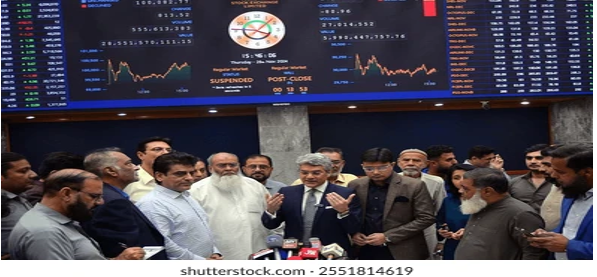
Credit: INP-WealthPk
Related Articles