INP-WealthPk
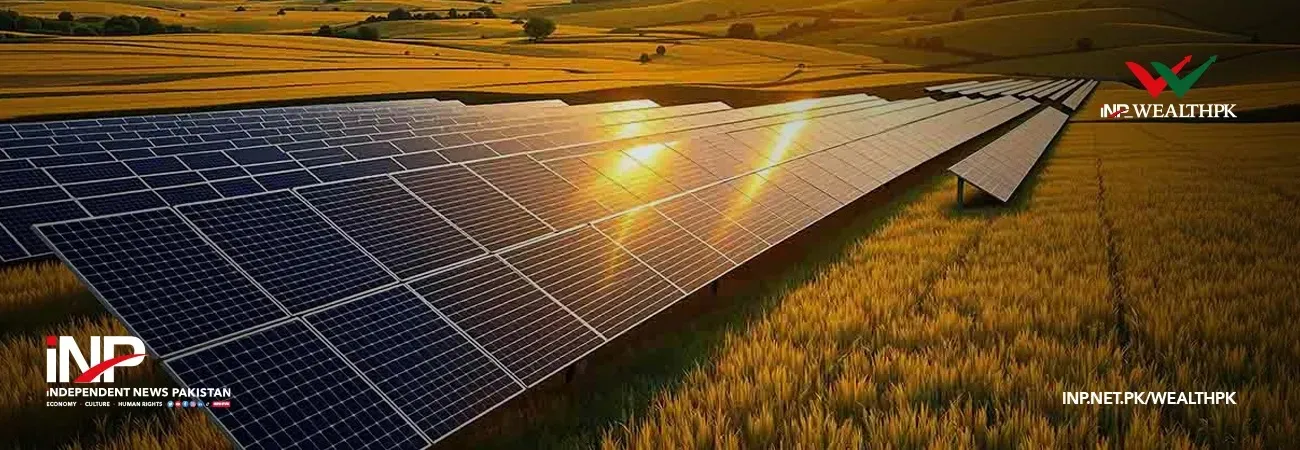
Net billing may cut solar-related revenue exposure, but not DISCO stress
June 11, 2026
By Moaaz Manzoor
Pakistan’s transition from net metering to net billing is expected to reduce distribution companies’ revenue exposure from rooftop solar exports to Rs21.97 billion from Rs52.93 billion, but it will not resolve the underlying issues of losses, weak recoveries and tariff distortions that continue to strain the power sector. According to a PIDE Knowledge Brief available with Wealth Pakistan, net-metered electricity exports reached 1,997.33GWh in FY2024-25.
At retail-equivalent tariff rates, these exports created a revenue exposure of Rs52.93 billion for distribution companies. Under net billing, where exported electricity is valued at around Rs10-11 per unit, the exposure falls to Rs21.97 billion, implying a reduction of nearly Rs31 billion. The policy shift also marks a significant change for rooftop solar consumers. Under the previous net-metering regime, surplus electricity was credited at around Rs25-26 per kWh, allowing consumers to offset grid consumption almost on a one-to-one basis.
Under the Prosumer Regulations, 2026, exported electricity will be purchased at the National Average Energy Purchase Price of approximately Rs10-11 per kWh. For consumers, this means lower returns on surplus solar generation. The brief estimated that a typical 10kW residential solar system previously had a payback period of around four to five years, depending on consumption patterns. Under net billing, the payback period could increase to seven to nine years for import-reliant systems, assuming 60 percent self-consumption and an export rate of Rs11 per unit.
The report observed that rooftop solar has expanded rapidly in Pakistan as consumers responded to rising electricity tariffs and unreliable power supply. Net-metered capacity has already crossed 5GW, while total distributed solar capacity is considerably higher when off-grid and behind-the-meter installations are included. Retail tariffs in many urban slabs have reached Rs35-40 per unit, making rooftop solar an attractive hedge against rising electricity costs. However, the PIDE brief cautioned against viewing net metering in isolation from the broader condition of Pakistan’s distribution companies.
It said that even modest net-metering penetration of 2-3 percent of DISCO sales can increase financial pressure on utilities already struggling with high transmission and distribution losses and weak recovery rates. The study developed a composite DISCO Stress Index based on losses, net-metering penetration and recovery performance. The findings showed that financial stress is concentrated in weaker utilities, rather than solely in companies with the highest levels of solar adoption.
QESCO ranked as the most stressed DISCO, with a stress index of 2.21, followed by HESCO at 1.52, SEPCO at 1.42 and PESCO at 1.31. Although LESCO recorded the highest net exports at 840.34GWh, its stress index was lower at 1.17, indicating that rooftop solar penetration alone does not explain financial distress. According to the brief, the main drivers of DISCO stress remain energy losses, electricity theft, poor recoveries, deferred investment and tariff distortions. While rooftop solar may amplify existing weaknesses in some utilities, it is not the primary cause of financial difficulties in the distribution sector.
The transition to net billing could also alter consumer behaviour. Lower export compensation may encourage solar users to invest in batteries and hybrid systems to maximise self-consumption rather than exporting excess electricity to the grid. While this could reduce immediate export-credit pressure on DISCOs, it may also lower future grid sales from higher-income consumers. The brief further noted that net metering has mechanically increased per-unit capacity charges by Rs0.1-0.5 per kWh, adding to tariff pressures in an already fragile distribution system. The study, titled “From Net Metering to Net Billing: Tariff Design and Distribution-Sector Stress in Pakistan,” was authored by Dr Rubina Ilyas, Research Economist at Pakistan Institute of Development Economics, and Bilal Aftab, Staff Economist at the institute.
The brief recommended reducing DISCO losses and recovery gaps alongside solar-sector reforms, implementing net billing through a transparent and predictable export-pricing framework, and integrating rooftop solar expansion with feeder-level planning, network upgrades and preparations for battery-based hybrid systems. Its central conclusion is that while net billing may provide short-term financial relief, Pakistan’s distribution-sector stress will persist unless losses, recoveries, governance shortcomings and fixed-cost recovery challenges are addressed.
Credit: INP-WealthPk
Related Articles