INP-WealthPk
Pakistan eyes broader battery ecosystem after Chinese firm’s $15m Faisalabad investment
May 18, 2026
By Hasan Salahuddin
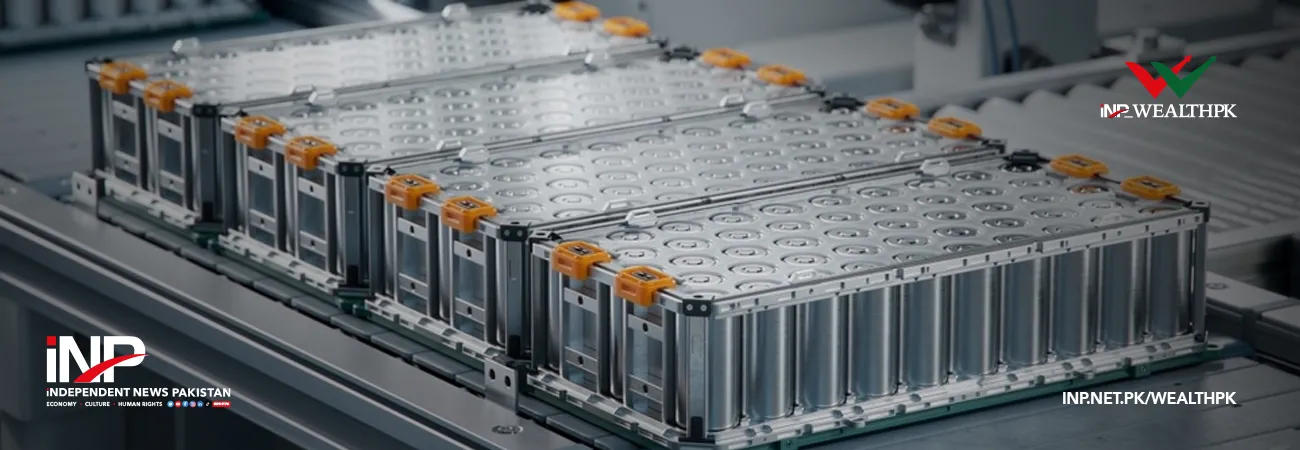
Pakistan’s planned dry battery manufacturing plant with China’s Dongjin Group is being viewed by industry experts as a potential starting point for building a broader domestic battery ecosystem, following the recent signing of a $15 million agreement between the Punjab Board of Investment and Trade and the Chinese company.
The project, to be established in Allama Iqbal Industrial City near Faisalabad, is expected to support localisation of energy storage production and reduce Pakistan’s growing dependence on imported batteries amid rising domestic demand.
The development comes at a time when China has further strengthened its position as the world’s leading battery manufacturing hub.
According to the International Energy Agency, China produced nearly 80 percent of global battery cells in 2024 while supplying around 85 percent of cathode active materials and more than 90 percent of anode active material production worldwide.
The China Automotive Battery Innovation Alliance reported that during the first four months of 2026 alone, China produced 671.3 gigawatt-hours of power and energy-storage batteries, marking a 51 percent year-on-year increase, while combined battery exports rose 38.1 percent to 115.8 GWh.
Dongjin Power, headquartered in Shenzhen, operates manufacturing facilities in Guangdong and Jiangxi provinces and employs more than 4,000 workers. The company produces both lead-acid and lithium battery products for electric vehicles, home energy storage and telecom base station applications.
The company has already maintained a presence in Pakistan since 2019 and began local manufacturing operations in 2021.
Meanwhile, Pakistan’s dependence on imported batteries continues to rise rapidly.
According to Pakistan Bureau of Statistics and State Bank of Pakistan data, battery imports surged to $101.8 million during the first five months of FY2025-26, compared with $56.6 million during the same period last year, reflecting an increase of nearly 80 percent.
At the same time, the Pakistan Credit Rating Agency reported that local storage battery production declined 26.1 percent during FY2024-25 to 112,897 units, partly because consumers increasingly shifted from locally produced lead-acid batteries toward imported lithium-ion alternatives.
The Institute for Energy Economics and Financial Analysis estimated that Pakistan’s lithium-ion battery imports stood at around 1.25 GWh during FY2024-25 and could increase to 8.75 GWh by 2030, highlighting the urgency of developing domestic manufacturing capacity.
Energy and industrial experts say the Dongjin investment could become an important opportunity for Pakistan to move beyond simple battery assembly toward a more integrated industrial base.
Dr Ghulam Ali, Head of Department Research at the U.S.-Pakistan Center for Advanced Studies in Energy at NUST, told Wealth Pakistan that the next major priority should be the development of indigenous manufacturing capacity for upstream battery materials.
He identified battery-grade graphite, LFP or NCM cathode materials, aluminium and copper foils, separators and electrolytes as critical components that Pakistan would eventually need to produce locally.
“A disruption in the supply of even one of these components could halt battery production entirely,” he noted, stressing the importance of building local supply chain resilience.
According to Dr Ali, supporting local production and encouraging investment in battery materials could help Pakistan reduce import dependence while strengthening long-term industrial sustainability.
Dr Waleed Jan, Assistant Professor at the Department of Electrical Engineering at CECOS University of IT and Emerging Sciences, described the agreement as a positive development for Pakistan’s industrial and energy sectors.
However, he said the project’s long-term value would depend on whether Pakistan could use it to build technical expertise, local supply chains and energy storage capabilities linked to solar power and electric vehicles.
He cautioned that limiting the project to basic assembly using imported materials would reduce its broader industrial impact.
“Without a long-term industrial strategy, the project risks becoming another low-value assembly operation rather than a genuine industrial transformation,” he said.
Dr Jan added that Pakistan should use the investment to strengthen local engineering development, technology transfer and battery recycling infrastructure.
Hassan Shahbaz, Head of Battery Department at Zyp Technologies, also described the agreement as important for Pakistan’s emerging battery sector.
He said Dongjin’s experience across multiple battery technologies could help Pakistan develop modern battery assembly capabilities while supporting industries linked to solar energy, UPS systems, electric bikes and energy storage solutions.
According to him, Pakistan’s battery market remains dominated by a limited number of manufacturers, while a large share of batteries and raw materials continues to be imported.
He said local production initiatives could help reduce import pressure, save foreign exchange and create technical employment opportunities.
“The real long-term benefit lies not only in battery production itself but in the supply chain and technical knowledge that develops around it,” he said, adding that building a domestic battery ecosystem would ultimately matter more than simply accessing cheaper batteries.
Industry observers believe the Punjab-Dongjin agreement could become an important entry point into one of Pakistan’s most strategically significant industrial sectors if supported by consistent industrial policy, technology transfer and local supply chain development.
Credit: INP-WealthPk