



INP-WealthPk
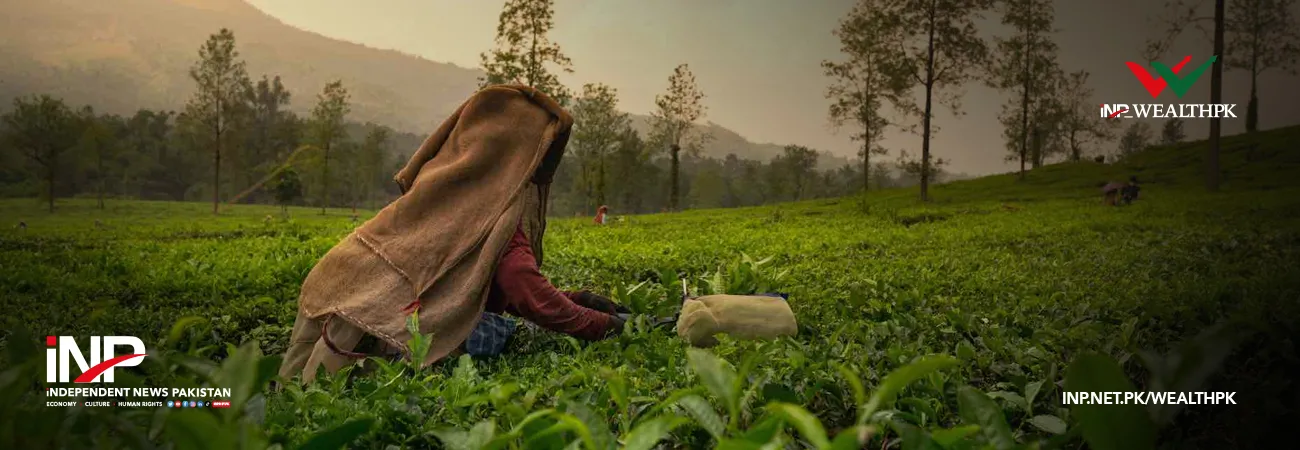
Pakistan targets 600 acres of tea by 2030 to reduce $600m import dependence
December 13, 2025
Ayesha Saba
Pakistan has set a target to bring 600 acres under tea cultivation by 2030 as part of an initial expansion plan aimed at gradually reducing the country’s annual tea import bill of around $600 million, according to a strategy document available with Wealth Pakistan.
The report notes that Pakistan’s dependence on imported tea cannot be significantly reduced in the short term because replacing current imports would require an estimated 440,000 acres of tea plantations—an area far beyond the country’s present capacity.
However, the strategy positions the first-phase target of 600 acres as a critical starting point for establishing supply chains, processing infrastructure, and farmer adoption practices required for future scaling.
According to the document, Phase-1 of the programme (2025–2030) includes infilling and restoration of existing smallholder plots, development of identified cluster sites and gradual expansion into larger state-owned plantation areas. The plan is based on three land-use models: smallholders with plots under five acres, cluster farms with contiguous land parcels exceeding 20 acres under individual ownership, and plantation blocks of 100 acres or more located on suitable state or forest land.
The report states that within KP’s Mansehra district alone, 31 smallholders currently maintain tea bushes planted earlier, although many plots require substantial rehabilitation. In addition, 10 cluster sites totalling approximately 1,026 acres have been mapped and assessed as technically suitable for tea cultivation. These locations satisfy requirements such as sloped terrain, soil pH between 4.5 and 6, sufficient soil depth, and access to natural or irrigated water sources.
The strategy document explains that Phase-1 will focus on producing 2.4 million tea plants through nursery expansion, enabling planting to begin at a manageable pace and ensuring uniform field density. Existing germplasm, particularly the P3, P5, P7 and P8 clones used for black tea, along with Qimen varieties for green tea, will be used to support early-stage establishment until broader varietal decisions are finalised based on market demand.
The report emphasises that while Pakistan’s tea import bill is large, the purpose of the domestic cultivation programme is not to create a mass-market commodity but to develop a premium-quality, specialty-driven industry. It notes that Pakistan’s terrain favours orthodox and specialty teas rather than high-volume CTC varieties, and the national strategy therefore prioritises quality, branding and value addition instead of competing with low-cost tropical producers.
According to the document, the 600-acre target by 2030 will also allow authorities to collect data on plant performance, yield patterns, labour requirements, processing needs and commercial viability. These findings will guide planning for subsequent expansion phases expected in 2035 and 2040.
The report highlights that growing tea is a long-term undertaking, with plants requiring up to eight years to reach full commercial output. It states that the pace of progress will depend on land availability, farmer uptake, financing mechanisms, extension support and consistency in policy implementation. Without a sustained approach, the document warns, expansion will remain constrained, and previous outcomes may repeat.
Despite these challenges, the strategy maintains that the planned acreage for 2030 will lay the foundation for a broader industry while modestly contributing to reducing Pakistan’s reliance on imported tea. It notes that consumer preferences can shift over time, recalling that Pakistan consumed Sri Lankan orthodox teas for many years after 1971, and that younger consumers may be more open to premium domestic blends once available.
Credit: INP-WealthPk