



INP-WealthPk

Traditional textile exports fall to five-year low of $1.786bn in Jul–Jan FY26
March 06, 2026
By Ayesha Saba
Pakistan’s traditional textile exports (Chapters 50–60) declined to $1.786 billion during July–January FY26, marking the lowest level recorded for the corresponding period over the past five years, according to the Monthly Report of Pakistan’s Textile & Apparel Exports prepared by the Pakistan Textile Council (PTC)
Exports in this segment stood at $1.938 billion in July–January FY25. The drop to $1.786 billion in FY26 reflects a 7.83% year-on-year decline, underscoring continued weakness in raw and semi-processed textile categories.
The report’s five-year trend analysis shows a sustained downward movement in traditional textile exports. During July–January 2021–22, exports reached $2,513 million. They fell to $2,118 million in 2022–23, before posting a slight recovery to $2,166 million in 2023–24. However, the decline resumed in 2024–25, when exports dropped to $1,938 million, and further contracted to $1,786 million in 2025–26.
Overall, exports in this category have declined by approximately $727 million compared to the July–January 2021–22 level, highlighting structural pressures in conventional textile segments.
On a monthly basis, however, January 2026 showed improvement. Exports under Chapters 50–60 were recorded at $297 million in January 2026, representing a 3% increase compared to $287 million in January 2025. On a month-on-month basis, exports rose sharply by 39%, climbing from $214 million in December 2025.
Despite this monthly rebound, the cumulative July–January performance remains significantly below previous years.
Cotton (Chapter 52), the largest component within traditional textiles, declined from $1,580 million in July–January FY25 to $1,448 million in FY26, reflecting an 8.35% decrease. Man-made filaments (Chapter 54) fell from $43 million to $34 million, marking a 20.65% contraction, while knitted or crocheted fabrics (Chapter 60) declined by 27.67%, from $26 million to $19 million.
Other vegetable textile fibers (Chapter 53) recorded the sharpest percentage drop, falling 34.31% from $5 million to $3 million. Wadding, felt and nonwovens (Chapter 56) declined by 12.82%, carpets (Chapter 57) by 10.08%, and man-made staple fibers (Chapter 55) by 2.33%.
In contrast, a few categories posted gains. Special woven fabrics (Chapter 58) rose 31.78%, increasing from $21 million to $28 million, while impregnated, coated or laminated textile fabrics (Chapter 59) grew by 9.26%. Wool and animal hair (Chapter 51) also recorded a 4.54% increase.
The data, based on calculations from Pakistan Single Window (PSW) and Pakistan Bureau of Statistics (PBS), confirm that traditional textile exports remain under pressure and have reached their lowest July–January level in five years.
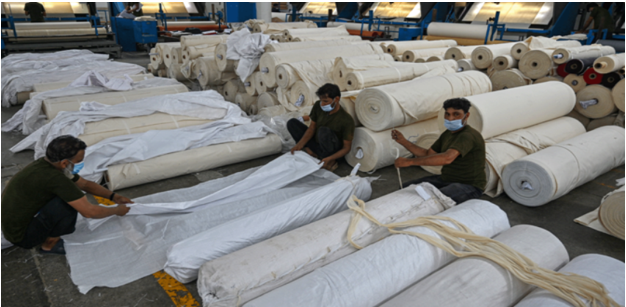
Credit: INP-WealthPk
Related Articles