i INP-WEALTHPK
Pakistan’s Phase-1 tea programme requires Rs574.9m in public financingBreaking
December 13, 2025
Farooq Awan
Pakistan will require an estimated Rs574.9 million in public financing to implement Phase-1 of its tea cultivation programme, with multiple domestic and international funding channels identified to support expansion, according to a strategy document prepared under the FAO Technical Cooperation Programme.
The report, available with Wealth Pakistan, states that while Pakistan has favourable terrain for high-value specialty tea, financing remains the primary barrier to early-stage expansion. Tea cultivation requires significant upfront investment, with plants taking up to eight years to reach full commercial maturity. As a result, the strategy proposes that the government provide interest-free financing support for the first five years to enable successful plantation establishment.
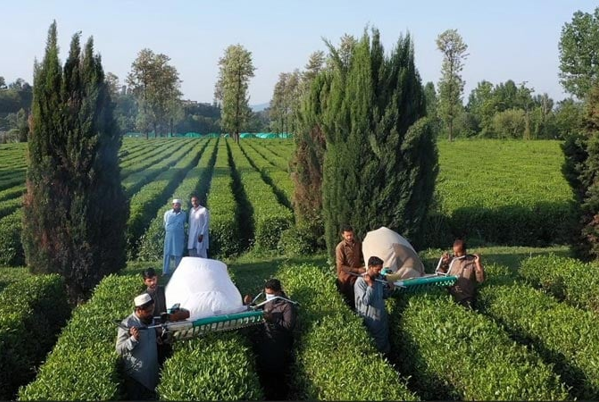
According to the document, the total requirement for Phase-1 (2025–2030) stands at Rs574.925 million. This covers planting material, nursery development, land preparation, shading structures, field care, intercropping support and technical services needed to establish 600 acres of tea by 2030. Loan repayments would begin in year eight and continue over a 10-year schedule.
The report estimates that the cumulative interest cost to the government for providing this long-term support is around Rs355 million. The strategy warns that without guaranteed early-stage financing, private investors and farmers are unlikely to enter the tea business because of the delayed returns and specialised knowledge required. The document notes that previous attempts at tea development stalled due to inadequate financing and inconsistent institutional support.
To meet funding needs beyond the government’s contribution, the strategy identifies several external and domestic financing channels. One of the most significant is the China-Pakistan Economic Corridor (CPEC), where Chinese tea companies have expressed interest in investing in plantations and processing facilities in Pakistan. The report notes that one company has proposed supporting an initial 2,470 acres with a longer-term target exceeding 16,000 acres, although the document points out that the proposal requires alignment with national technical standards.
The German-funded Billion Tree Afforestation Support Programme (TBTASP) is also identified as a potential contributor. The programme’s focus on forest sustainability, nature-based livelihoods and sloping terrain management aligns closely with the requirements of tea cultivation. The report states that the KP Forest Department has already indicated support for assisting smallholder and cluster-model growers.
In addition, the Turkish Cooperation and Coordination Agency (TIKA) has signalled its willingness to support machinery, equipment and capacity-building for growers, including assistance with processing units. TIKA previously provided a black-tea processing facility and an agricultural microbiology laboratory to Pakistan, and the document notes the agency’s interest in continuing this cooperation.
The World Bank–supported Resilient and Accessible Microfinancing (RAM) programme, launched with a $102 million climate risk fund, is also highlighted as a potential avenue. The strategy notes that tea cultivation meets multiple RAM objectives, including climate adaptation, climate-smart agriculture, gender-inclusive economic opportunities and support for vulnerable mountain communities.
The document further identifies local funding mechanisms, including the Pakistan Tea Association in Peshawar, Chambers of Commerce and the Military’s Green Pakistan Initiative, which holds long-term lease authority over marginal lands suitable for perennial crops.
According to the document, no single financing channel is sufficient on its own. Instead, a combination of government-backed loans, donor financing, private-sector partnerships and provincial support will be required to execute the first phase and build investor confidence for larger expansion in later years.
Credit: INP-WealthPk
Related News