

آئی این پی ویلتھ پی کے

Pakistan can boost yields, cut 60% water losses by adopting China’s high standard farmland model
March 04, 2026
By Hasan
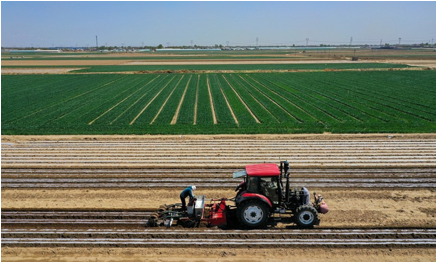
Pakistan can raise agricultural productivity and reduce water wastage by adapting China’s high standard farmland model, experts say, but reforms must begin with land consolidation through voluntary clustering, irrigation upgrades, and shared access to machinery before moving toward advanced automation.
High standard farmland refers to upgraded cropland equipped with modern irrigation, drainage, and infrastructure designed to ensure stable and higher yields.
Speaking with Wealth Pakistan, Dr Fida Hussain, Scientific Officer at Ayub Agricultural Research Institute, Faisalabad, identified land fragmentation as the primary structural barrier to modernization.
“The most fundamental issue is extreme land fragmentation,” he said, noting that around 90% of farms in Pakistan are under 5 hectares (12.5 acres), while roughly 55% are smaller than 1 hectare (2.5 acres).
Such small and scattered holdings make it difficult to introduce mechanisation, precision farming, or modern irrigation systems at scale.
He added that inefficiencies in water management further compound the problem. “Nearly 60% of irrigation water is lost through seepage, leakage, and outdated flood irrigation methods before it even reaches crops.”
Dr Hussain said Pakistan could follow China’s sequencing strategy: “Build scale first, add technology later.”
He proposed a voluntary cluster model in which farmers from the same village pool their land for collective cultivation while retaining legal ownership of their individual plots. This would allow modern inputs and machinery to be deployed efficiently across larger operational units.
As an alternative pathway, he suggested designated high-productivity agricultural zones where farmers voluntarily enroll under structured programmes supported by public infrastructure and private agribusiness services, including pre-agreed purchase contracts.
Hadeed Ashraf, Scientific Officer at Pakistan Agricultural Research Council (PARC), Islamabad, highlighted Pakistan’s mechanisation shortfall.
“Pakistan currently stands at an estimated mechanisation level of just 35%, with farm power availability around 0.9 horsepower per acre,” he said.
By comparison, China has achieved mechanisation of 74% and farm power availability of 3.8 horsepower per acre.
To bridge this gap without burdening smallholders, Ashraf recommended developing machinery banks and custom hiring centres that allow farmers to rent tractors, harvesters, and precision equipment as needed.
“We need localized cluster-based service systems that allow small farmers to access modern machinery — essentially borrowing the machinery,” he said.
He added that Pakistan could gradually introduce pilot smart farms using Internet of Things (IoT)-based sensors, real-time data systems, and autonomous machinery, citing his visit to China’s Jiansan Jiang Agricultural High-tech Zone where GPS-guided autonomous cultivation is fully operational.
Farah Atiq, Senior Research Associate at the Policy Research and Advisory Council (PRAC), said weak research and development capacity also limits scaling of high standard farmland.
“The biggest barrier is the weak capacity of agricultural research institutions,” she said, citing assessments that identified underinvestment, outdated infrastructure, weak commercialization, and brain drain as major constraints.
She pointed out that Pakistan’s Planning Commission introduced cluster-based agricultural development under Vision 2025 in 2017, identifying 33 priority commodities. However, many targets remain incomplete.
“Pakistan can upgrade the existing 33 commodity cluster strategies by aligning them with current challenges and implementing them effectively,” she said.
Experts agree that Pakistan does not need to replicate China’s model overnight. Instead, reforms should proceed in phases:
First, organize farmers into voluntary clusters to overcome fragmentation. Second, upgrade irrigation and drainage to reduce water losses. Third, expand shared machinery services to raise mechanisation levels. Fourth, strengthen agricultural research delivery systems. Finally, introduce smart farming pilots and automation in selected zones.
By sequencing reforms in this manner, Pakistan can make modern agricultural technology workable for small farmers while improving yields, conserving water, and enhancing competitiveness.
Credit: INP-WealthPk
متعلقہ مضامین