

i INP-WEALTHPK
Beyond the dollar: Pakistan increases RMB use in China tradeتازترین
May 13, 2026
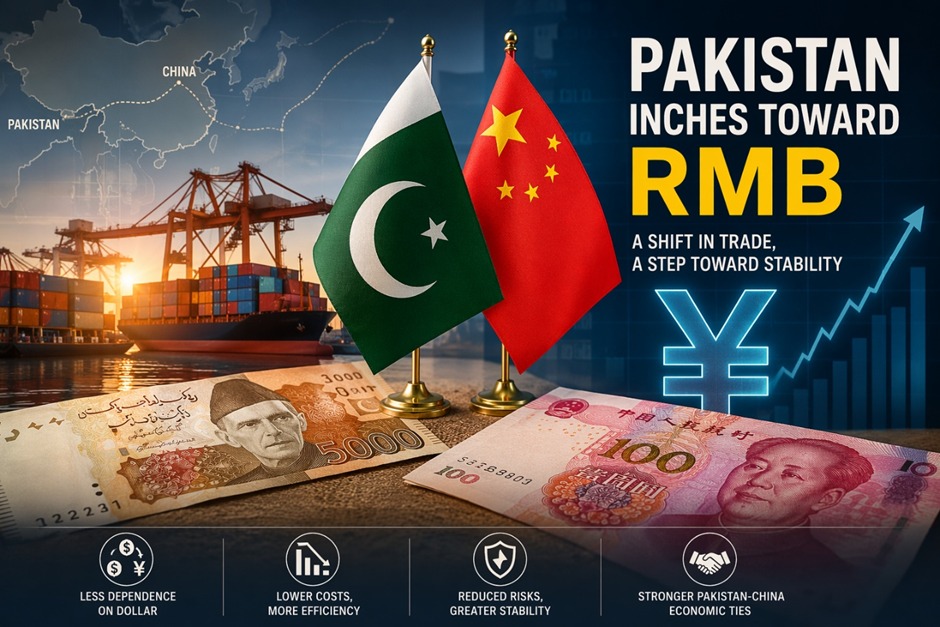
For decades, Pakistan’s trade—even with China—has relied heavily on the US dollar, leaving the country vulnerable to currency shortages and exchange rate shocks. Now, that pattern is beginning to change, with the Chinese renminbi (RMB) gradually gaining ground in bilateral trade as a practical way to ease pressure, lower costs, and improve economic stability. In the past, a typical Pakistani importer would first convert rupees into dollars and then into Chinese currency, adding extra costs and exposing businesses to exchange rate fluctuations.
That pattern, however, is steadily fading. Data from State Bank of Pakistan suggests that the transition toward RMB is already underway. The share of Pakistan-China trade settled in RMB has increased from just 2 percent in 2018 to over 14 percent in 2023. This trend reflects both growing trade volumes and deliberate policy support aimed at promoting direct currency settlement.
The State Bank of Pakistan has facilitated this transition by enabling RMB clearing arrangements through banks such as Industrial and Commercial Bank of China (ICBC), Bank of China, and Standard Chartered Bank. These mechanisms enable local businesses to settle payments directly in Chinese currency, eliminating the need to route transactions through the dollar and making trade more efficient.
This trend also aligns with global developments. According to “2023 RMB Internationalization Report” issued by The People’s Bank of China, the use of RMB in cross-border transactions has been rising steadily, with payments handled by Chinese banks reaching 42.1 trillion yuan in 2022. In the first nine months of 2023 alone, transactions amounted to 38.9 trillion yuan, showing strong growth.
According to CEIC’s “China Cross-border RMB Settlement: Trade 2010-2026” report, quarterly RMB settlement flows climbed to around 4.8 trillion yuan by late 2025, highlighting the currency’s expanding role in global trade. For Pakistan, one of the most immediate benefits is reduced pressure on foreign exchange reserves. Heavy reliance on the dollar has often strained Pakistan’s external account, especially during periods of high import demand.
By settling part of its trade with China in RMB, Pakistan can lower its demand for dollars and manage its reserves more effectively. This transition also supports the stability of the rupee. When fewer dollars are required for imports, fluctuations in the dollar exchange rate have a smaller impact on domestic markets, helping reduce volatility and uncertainty. At the business level, the benefits are even more tangible.
Under the traditional system, importers had to bear the cost of two currency conversions — each involving fees and exchange rate risks. With direct RMB settlement, these additional steps are removed. For example, consider a Pakistani importer purchasing industrial machinery worth Rs50 million from China. Under the traditional system, the importer would first convert rupees into US dollars and then convert those dollars into RMB to complete the payment.
Each step involved bank charges and exposure to exchange rate movements, meaning the final cost could increase if the dollar strengthened during the transaction period. With direct RMB settlement, the importer can now pay in Chinese currency without going through the dollar. This removes one layer of conversion, reduces transaction charges, and provides greater certainty about the final payment amount. As a result, businesses can better manage costs and avoid unexpected losses caused by currency fluctuations.
The development of local RMB infrastructure has further strengthened this transition. The designation of ICBC as an RMB clearing bank in Pakistan has created a formal system for liquidity, trade finance, and settlement services. Pakistani banks are increasingly offering RMB-denominated products such as letters of credit, guarantees, and financing facilities, making it easier for companies to integrate the currency into their operations.
This is particularly beneficial for small and medium enterprises, which often face higher transaction costs and greater exposure to currency volatility. Access to RMB-based financial services enables these businesses to manage payments more smoothly and plan their finances with greater confidence. The use of RMB also complements large-scale initiatives such as the China-Pakistan Economic Corridor (CPEC), where many transactions involve Chinese financing, imports, and long-term payments.
Settling these in RMB reduces currency mismatch risks and improves financial coordination between the two economies. From an industry perspective, financial practitioners increasingly argue that the expansion of RMB settlement should be actively encouraged rather than treated as a slow or passive trend. Farhan Ahmed, a finance manager at Soneri Bank, said Pakistani importers and exporters should proactively shift toward RMB invoicing in their dealings with Chinese counterparts.
He explained that such a shift can significantly reduce dependence on the US dollar, which has historically exposed businesses to sudden exchange rate shocks and liquidity constraints. “When firms rely heavily on the dollar, they remain vulnerable to volatility and shortages. Moving toward RMB enables businesses to operate with greater financial stability and reduced external pressure,” he noted.
Farhan further said that adopting RMB as a primary settlement currency can improve financial planning by providing greater predictability in pricing and payment cycles. According to him, when businesses align their invoicing currency with that of their main trading partner, they minimize currency mismatches and reduce the need for costly hedging strategies. “This alignment simplifies transactions and reduces uncertainty.
Companies can plan better, manage their cash flows more efficiently, and avoid unnecessary conversion costs,” he said. He also stressed that banks should expand RMB-based financing products, including letters of credit and trade finance facilities, to support this transition and enable businesses of all sizes to benefit from more efficient settlement mechanisms.
A similar view is shared by Tahir Awan, an assistant manager at Wallstreet Exchange Company, who believes that wider use of RMB can strengthen Pakistan’s overall currency market structure. He argued that businesses, particularly small and medium enterprises, should be encouraged to adopt RMB transactions as a way to diversify their foreign exchange exposure and reduce reliance on a single dominant currency.
“Relying on one currency increases systemic risk. Diversification, especially toward RMB in the case of China trade, can provide a more balanced and resilient framework for businesses,” he said. Tahir adds that increasing RMB usage can deepen Pakistan’s foreign exchange market by introducing more liquidity in alternative currencies, which in turn enhances overall market stability.
He noted that exchange companies and financial institutions should actively promote RMB-related services, including forward contracts and hedging tools, to facilitate smoother adoption. “With proper awareness and institutional support, RMB settlement can move beyond a niche practice and become a mainstream financial strategy for Pakistan-China trade,” he said. He added that sustained policy backing and market readiness will be key to accelerating this transition.
Beyond immediate economic benefits, the shift toward RMB carries long-term strategic importance. It deepens financial integration with China, supports regional trade connectivity, and aligns Pakistan with a broader global move toward currency diversification. As more countries explore alternatives to dollar-based trade systems, Pakistan’s early adoption of RMB positions the country to benefit from an evolving global financial landscape. Rather than replacing the dollar entirely, this approach focuses on reducing over-reliance — a gradual process of partial de-dollarisation.
In this context, expanding RMB settlement is not just a technical adjustment but a practical economic strategy. It lowers transaction costs, reduces financial risks, and strengthens external sector resilience. With usage already rising, institutional support in place, and clear advantages for businesses, RMB is steadily emerging as a viable alternative for Pakistan-China trade. In a world still dominated by the dollar, this shift offers Pakistan a realistic path to reduce its dependence and build a more stable, diversified economic future.
Credit: INP-WealthPk
متعلقہ خبریں