

i NEWS PAK-CHINA
Pak-China researchers to cooperate in advanced semiconductor technologiesتازترین
November 22, 2026
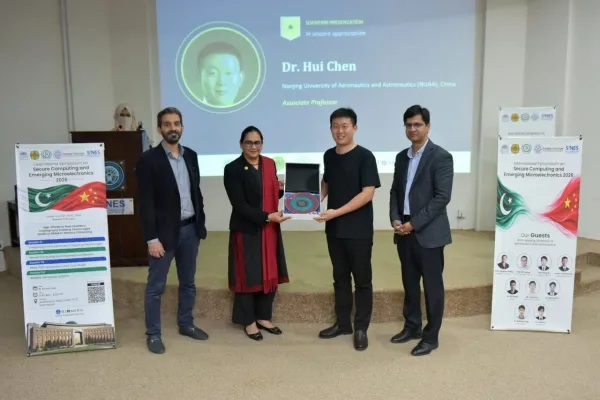
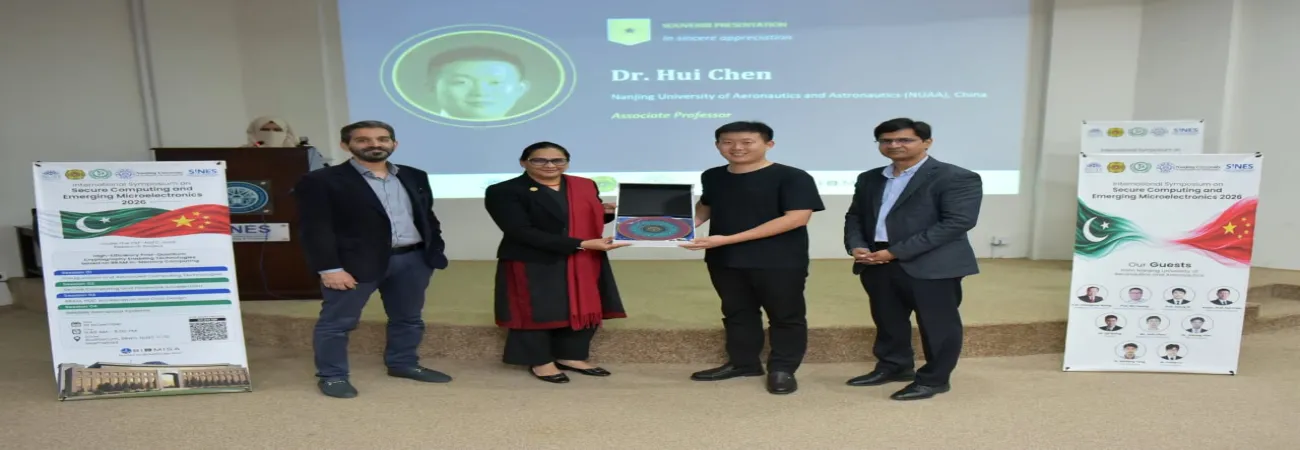
Researchers from Pakistan and China explored opportunities for collaboration in advanced semiconductor technologies at an international symposium hosted by the National University of Sciences and Technology (NUST).
According to an announcement, its BIOMISA Laboratory at the School of Interdisciplinary Engineering and Sciences (SINES) hosted the “International Symposium on Secure Computing and Emerging Microelectronics 2026”, bringing together Pakistani researchers and a nine-member delegation from China's Nanjing University of Aeronautics and Astronautics (NUAA), Gwadar Pro reported on Sunday.
Jointly funded by the Pakistan Science Foundation (PSF) and China's National Natural Science Foundation (NSFC), the symposium focused on developing faster, energy-efficient computer chips using advanced Resistive Random Access Memory (RRAM) technology.
RRAM is an emerging memory technology that can retain information without continuous power and offers potential for combining data storage and processing within the same hardware.
This approach, known as computing-in-memory, can reduce the movement of data between separate memory and processing units, helping lower energy consumption and improve computing efficiency.
China has been actively advancing research in this field. Researchers from Chinese institutions, including Tsinghua University and the Chinese Academy of Sciences, have published work on RRAM-based computing-in-memory architectures, with applications in artificial intelligence, high-performance computing and cryptographic operations.
Recent research has also explored the use of RRAM architectures to efficiently process mathematical operations required by post-quantum cryptography systems.
The technology is particularly relevant as the development of quantum computers raises concerns about the long-term security of conventional encryption systems.
While RRAM can provide efficient hardware for complex computing operations, quantum-resistant algorithms are separately required to protect sensitive digital information against potential future quantum attacks.
The NUST announcement said technical presentations enabled both institutions to combine their expertise in security algorithms, digital systems, chip manufacturing and hardware reliability testing.
Participants were also introduced to Pakistan University's Chip Design Centre (NCDC), providing an opportunity to explore the university's facilities and research capabilities in semiconductor design and development.
The symposium aimed to strengthen local capabilities in advanced semiconductor technology through research exchange and closer academic cooperation between Pakistan and China.
The engagement reflects opportunities for Pakistan to benefit from China's growing semiconductor research ecosystem through academic partnerships, technical knowledge exchange and collaboration in emerging computing technologies.
متعلقہ خبریں