INP-WealthPk
China’s AI Plus strategy offers Pakistan a roadmap for practical AI-led growth
March 17, 2026
By Hasan
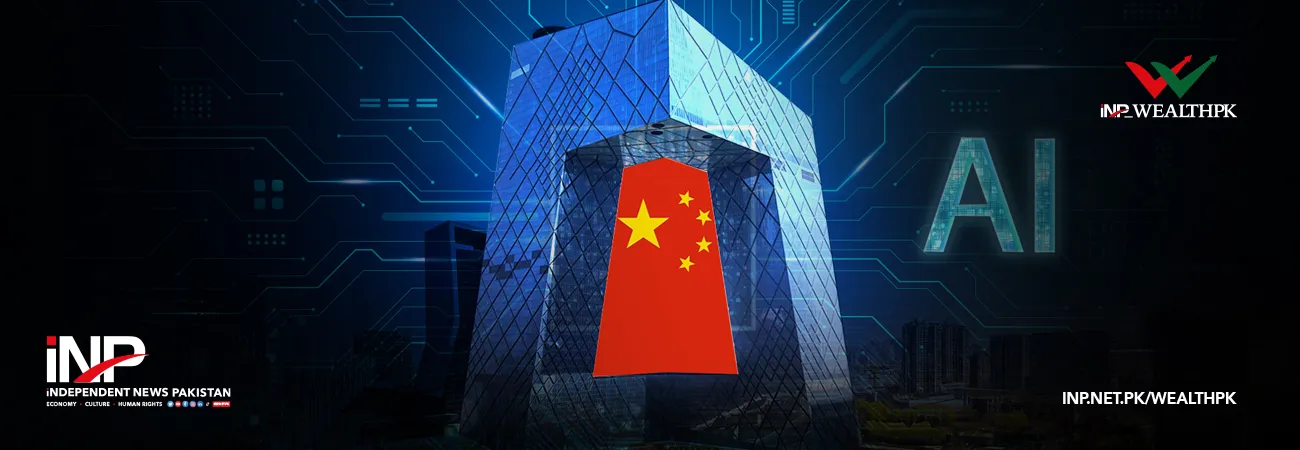
As China moves into the 15th Five-Year Plan period for 2026–2030, its “AI Plus” initiative is offering Pakistan a clearer model for practical artificial intelligence-driven growth, with experts pointing to targeted sector adoption, stronger infrastructure and better skills as the foundations for turning policy ambitions into measurable economic outcomes.
AI Plus refers to China’s strategy of integrating artificial intelligence into the real economy, public services and daily life to accelerate digital transformation and create new sources of growth. The concept was first introduced in China’s 2024 government work report and has since moved toward practical implementation through sector-specific guidelines and pilot initiatives.
China’s artificial intelligence industry has already grown rapidly. According to official figures, the country’s core AI industry reached a scale of more than 1.2 trillion yuan in 2025, while the number of AI-related companies surpassed 6,200. China’s top economic planner has projected that AI-related industries could exceed 10 trillion yuan by the end of the 15th Five-Year Plan period in 2030, highlighting the scale of the country’s push to embed artificial intelligence across the economy.
The growing adoption of AI in China’s industrial sector illustrates this transition from policy to application. By the end of 2025, more than 30 percent of manufacturing enterprises with annual main business revenue of at least 20 million yuan had adopted AI technologies to improve production efficiency and industrial automation.
With China placing the AI Plus strategy at the centre of its digital transformation agenda during the 2026–2030 planning period, experts believe Pakistan now has a clearer reference point for developing its own AI pathway.
Pakistan has already approved its National Artificial Intelligence Policy, 2025, providing a policy framework for developing its own AI ecosystem. Experts say Pakistan can begin by applying artificial intelligence in a few priority sectors where outcomes can be measured, while strengthening governance structures, improving energy reliability and expanding digital infrastructure.
Better alignment between universities, industry and training institutions would also help ensure that the benefits of AI adoption are distributed more widely across the economy.
Speaking with Wealth Pakistan, Dr Ammar Younas, China-based AI Ethics, Governance, and Compliance Advisor and CEO of Ai Mo Innovation Consultants, said Pakistan’s most practical lesson from China is the need for “sectoral embedding rather than standalone AI projects.”
He said targeted pilot initiatives in areas such as agriculture, remittance-linked financial technology and public service delivery could generate measurable outcomes and help policymakers understand where AI produces the most tangible benefits.
Such focused use cases, he noted, allow governments to test how artificial intelligence can improve productivity, expand service access and strengthen public-sector efficiency before expanding its application across the broader economy.
On the policy side, Younas said Pakistan still faces challenges in implementation and requires stronger institutional coordination. He called for an enforceable national AI governance framework and a central coordination body with sufficient authority and resources to oversee policy execution.
He also emphasized that reliable electricity, broadband connectivity, cloud infrastructure, data centres and interoperable government data systems are essential prerequisites for meaningful AI adoption.
“AI Plus cannot be grafted onto infrastructure deficits,” he said, adding that Pakistan may need to rely on public-private partnerships and donor-backed programmes to gradually build its AI capacity, given fiscal constraints.
Dr Muhammad Tariq, AI and Systems Interoperability Expert and CEO of Development Synergies International, said Pakistan’s National AI Policy 2025 already reflects elements of China’s approach but must adapt the strategy to local conditions.
“One shoe will not fit Pakistan, given our state of relative immaturity,” he said, noting that the country should focus on practical deployment rather than concentrating mainly on research.
He cited the China-Pakistan AI Smart Agriculture Laboratory in Faisalabad as an example of how artificial intelligence can support farmers through improved crop monitoring and yield optimization. He also pointed to potential applications in healthcare, including epidemic preparedness, precision medicine and more affordable diagnostic technologies.
According to Tariq, Pakistan’s plans to train AI professionals and instructors indicate that the country has begun developing its human resource base for the emerging technology sector. However, he said the real challenge will be converting policy plans into sector-level deployment.
Zohaib Altaf, Associate Director for Emerging Technologies, Strategy and Warfare at the Center for International Strategic Studies in Muzaffarabad, said Pakistan must view artificial intelligence as part of a broader economic modernization strategy rather than as a standalone technology initiative.
He said AI could support productivity improvements across sectors such as agriculture, financial services, energy management and public administration.
Altaf noted that energy capacity will remain a critical factor in AI development because data centres and computing infrastructure require a stable and reliable electricity supply.
He added that Pakistan could also learn from China’s use of smaller, sector-specific AI models that require less computing power but still deliver practical economic value.
In addition, stronger digital connectivity, expanded data centre capacity, closer collaboration between universities and industry, and workforce reskilling will be necessary to ensure that AI adoption generates broader economic opportunities.
Credit: INP-WealthPk
Related Articles