




INP-WealthPk

India’s jobless growth crisis: Why soaring GDP is failing its youth
August 07, 2026
By Qudsia Bano
India’s economy is expanding rapidly, but its labour market is not generating the kind of employment demanded by a growing and increasingly educated youth population.
The latest official estimate places real gross domestic product growth at 7.7 percent in the financial year ending March 2026, up from 7.1 percent a year earlier. Yet unemployment among people aged 15 to 29 stood at 9.9 percent in 2025. The rate was considerably higher in urban areas at 13.6 percent. Moreover, one-quarter of Indians in this age group were not in employment, education or training.
These figures reveal a problem deeper than open unemployment. Many families cannot support prolonged job searches. Consequently, young people often accept unpaid family work, casual labour, platform work or very small-scale self-employment.
Official statistics may count them as employed even when their earnings remain irregular and their productivity is low. Their work may also offer no clear path towards advancement. India’s growth paradox is therefore not that its economy creates no work. Instead, output is expanding much faster than the supply of secure, productive and adequately paid jobs.
Two structural weaknesses lie at the centre of this crisis. The first is India’s failure to build a sufficiently large employment-intensive manufacturing base. The second is its shortage of medium-sized firms capable of hiring workers at scale. Other problems, including skills mismatches and technological disruption, have intensified the pressure but are not its primary cause.
India’s incomplete structural transformation provides the starting point. Agriculture generated around 17 percent of gross value added in the latest national accounts, but it still employed 43 percent of workers in 2025. Manufacturing contributed about 14 percent of gross value added and accounted for only 12.1 percent of employment.
Meanwhile, financial, real estate, and professional services accounted for nearly one-quarter of gross value added. This reflects how strongly India’s growth model has tilted towards modern services.
The imbalance matters because different sectors have very different capacities to absorb labour. Agriculture can conceal underemployment when several family members share work that fewer people could perform. Modern services generate substantial output, exports and tax revenue, but they usually require specialised skills, higher-quality education and access to major urban centres.
As a result, these services cannot easily absorb millions of people leaving farms or graduating from ordinary colleges. Labour-intensive manufacturing has historically provided that bridge in other developing economies. It offers relatively accessible jobs while allowing workers to move into more productive and better-paid employment.
India has not failed entirely in manufacturing. Its automobile, pharmaceutical, electronics and engineering industries have expanded. The Economic Survey reports that organised manufacturing added more than one million jobs in the financial year ending March 2024. Over the previous decade, it created more than 5.7 million jobs.
Organised manufacturing now employs about 19 million people, while unorganised manufacturing employs around 33 million. These are meaningful gains. However, manufacturing’s overall employment share remains too small for a country adding millions of young jobseekers to its labour force.
The composition of industrial growth helps explain this gap. India is increasingly seeking competitiveness in electronics, advanced machinery, pharmaceuticals, clean energy and other technology-intensive industries. These sectors are strategically important and can strengthen domestic supply chains. However, their direct employment gains may remain limited relative to the capital invested.
A highly automated electronics plant can increase production without recruiting workers on the scale required for garments, footwear, food processing, furniture, or light engineering. Similarly, infrastructure projects may create substantial employment during construction but require far fewer permanent workers after completion.
This does not mean that India should choose workers over machines. Rejecting technology would weaken productivity, exports and wage growth. The policy weakness is the absence of a parallel strategy large enough to develop labour-intensive manufacturing and employment-rich services.
Authorities generally assess industrial progress through investment attracted, factories announced and production generated. A more employment-focused approach would also measure jobs created, wages paid, apprentices trained and local suppliers developed. Without such indicators, public incentives may raise output while leaving the labour-absorption problem largely unresolved.
The second major weakness is India’s fragmented business landscape. According to the Economic Survey, the unincorporated non-agricultural sector contained about 79 million establishments and employed 129 million people in the second quarter of the financial year ending March 2026. Working owners accounted for 60 percent of employment in the sector.
These figures demonstrate enormous entrepreneurial activity, but they also expose a structural weakness. A very large number of businesses remain too small to develop professional management, join export supply chains or employ salaried workers at scale.
The broader labour data reflect this fragmentation. Self-employed workers accounted for 56.2 percent of employment in 2025. Only 23.6 percent held regular wage or salaried positions, while 20.2 percent worked as casual labour.
Self-employment can represent successful entrepreneurship. At such a large scale, however, it may also serve as a refuge when established firms are not creating enough paid positions. A young graduate running a tiny shop or assisting in a household enterprise may be economically active without using the education and skills in which the family invested.
This is India’s “missing middle.” The country has millions of microenterprises and a group of highly productive corporations, but too few firms grow into stable, medium-sized enterprises capable of employing workers at scale.
Small businesses often face restricted credit, delayed payments, compliance costs, weak infrastructure and limited access to larger markets. They may also struggle to recruit skilled managers or adopt modern technology. Remaining small can therefore become a rational survival strategy.
The result is a broken employment ladder. Microenterprises usually cannot offer structured careers, training or adequate wages. At the other end, large companies recruit selectively and increasingly demand specialised qualifications and previous experience. Too few firms exist between these two ends to provide young workers with their first stable job.
India’s apprenticeship system illustrates the consequences. The Economic Survey says more than 990,000 apprentices enrolled under the National Apprenticeship Promotion Scheme in the financial year ending March 2026. However, only about 6,100 enterprises actively provided training. This remains extremely limited compared with India’s vast enterprise base.
India therefore faces not only a skills problem but also a shortage of firms able and willing to transform classroom education into workplace competence. Expanding training without increasing the number and capacity of employers will produce limited results.
This weakness helps explain why graduate unemployment is much higher than the overall youth rate. The State of Working India 2026 report found unemployment of nearly 40 percent among graduates aged 15 to 25 and about 20 percent among those aged 25 to 29. It also found that only a small proportion secured stable salaried employment within a year of graduating.
Educational quality forms part of the problem, but inadequate labour demand is equally important. Training alone cannot produce suitable employment when labour-intensive sectors and medium-sized companies are not expanding fast enough.
Long queues for government employment are one response to this weak private market. Dr Farah Haider, professor of economics and labour economist at the Lahore University of Management Sciences, offered a wider South Asian perspective.
Her research on preferences for public-sector employment in Pakistan found that applicants seeking government jobs experienced longer periods of unemployment. Security, benefits and working conditions appeared to matter more than wage advantages alone.
Applied cautiously to India, the finding suggests that waiting for a government position is not merely a cultural preference. It also signals that many private-sector jobs fail to provide comparable stability, dignity and career progression.
Technology is likely to intensify these pressures, but it is not their original cause, Dr Haider told Wealth Pakistan. India’s information technology and outsourcing companies are shifting towards artificial intelligence, cloud services, data engineering and cybersecurity, making recruitment more selective.
Companies can increasingly automate routine coding, documentation, data processing and customer-support functions or perform them with smaller teams. At the same time, India’s Economic Survey has warned that unchecked replacement of workers through automation could have destabilising consequences in a labour-rich economy.
The gig workforce has expanded to about 12 million people, but around 40 percent reportedly earn less than ₹15,000 per month. Technology is creating new opportunities, but it is also transforming some junior positions through which young people traditionally acquired workplace experience.
According to Dr Haider, India must change the employment content of growth rather than slow growth itself. The National Mission on Manufacturing aims to increase manufacturing’s contribution to the economy and generate 143 million jobs by 2035. Reaching that target will require more than large factories and headline investment commitments.
Industrial incentives should incorporate measurable targets for employment, apprenticeships, workforce training and wage growth. Credit, public procurement and export policies should also help micro and small firms become medium-sized suppliers. In addition, universities should track graduate employment outcomes, while companies should assume greater responsibility for first-job training.
India’s demographic dividend will not be secured merely by counting every economic activity as a successful job. It will depend on whether young people can move from education into work that raises their productivity, income and independence.
Unless India expands employment-intensive manufacturing and builds the missing middle of its business sector, high GDP growth will continue to coexist with educated frustration. The economy may become larger and more technologically advanced while too many young citizens remain stuck at the gates of opportunity.
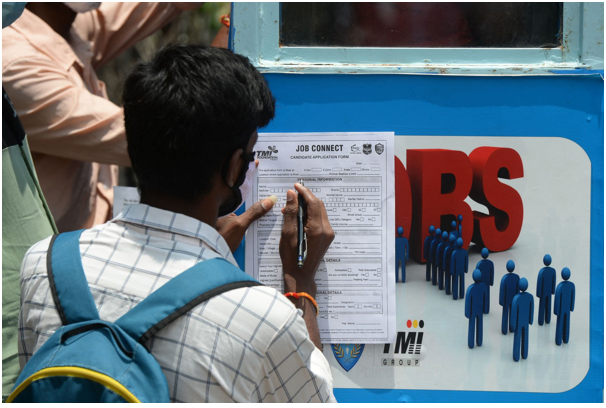
Credit: INP-WealthPk
Related Articles


