


INP-WealthPk
Pakistan takes SCO reins, puts connectivity and shared prosperity at centre stage
September 02, 2026
By Farooq Awan
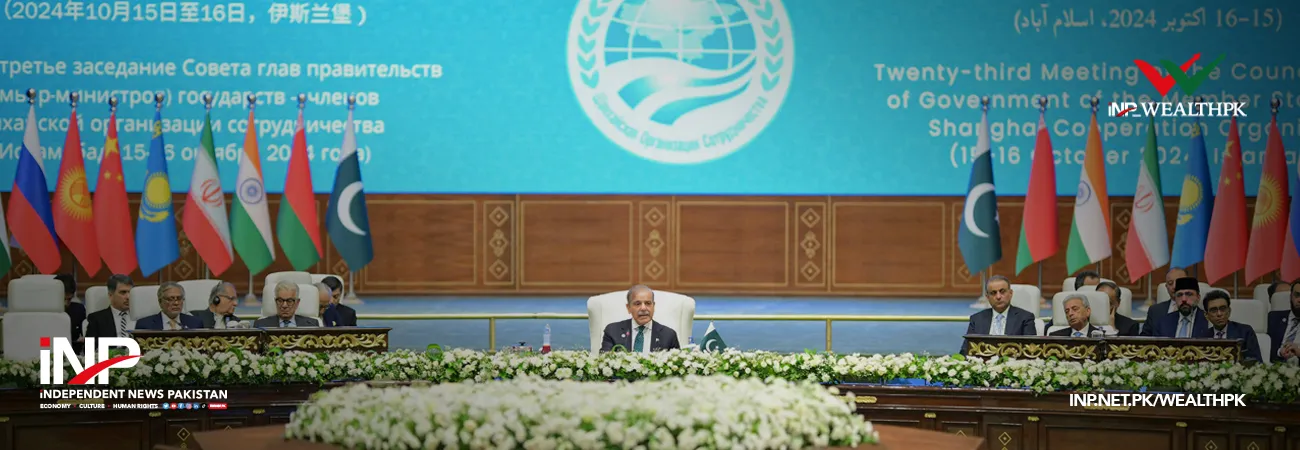
Pakistan on Tuesday assumed the 2026-27 chairmanship of the Shanghai Cooperation Organisation (SCO) Council of Heads of State, taking over from Kyrgyzstan.
Kyrgyzstan formally handed over the chairmanship to Pakistan following the SCO summit in Bishkek, Kyrgyzstan’s AKIpress news agency reported.
“Kyrgyzstan is completing its chairmanship in the SCO,” Kyrgyz President Sadyr Japarov said, wishing Prime Minister Shehbaz Sharif success as Pakistan assumed the responsibility.
As chair of the Council of Heads of State, the SCO’s highest decision-making body, Pakistan will host the organisation’s next summit in 2027.
The handover took place at the conclusion of the council meeting attended by leaders of SCO member states. Prime Minister Shehbaz and other participating leaders also signed the summit’s joint declaration.
Addressing the summit earlier, Prime Minister Shehbaz announced that Pakistan would conduct its chairmanship under the theme “Turning Vision into Action: Connectivity, Innovation and Shared Prosperity.”
He proposed an action plan prioritising information technology and artificial intelligence, energy cooperation, development and poverty reduction, disaster management, health, culture and sports.
The prime minister also proposed establishing an SCO sovereign artificial intelligence infrastructure and governance framework to promote responsible and inclusive AI development and ensure that no member country was left behind.
He said Pakistan was assuming the responsibility with the conviction that connectivity would bring the region’s people closer, innovation would create new opportunities and the benefits of shared prosperity would reach every household.
Highlighting the economic potential of the SCO region, Shehbaz described regional connectivity as essential to prosperity. He said the China-Pakistan Economic Corridor continued to serve as a gateway linking regional economies to the Arabian Sea.
Pakistan, he added, remained committed to advancing trans-regional railway projects, road connectivity initiatives and regional energy schemes.
The prime minister reaffirmed Pakistan’s commitment to multilateralism and the peaceful resolution of disputes in accordance with international law and the charters of the United Nations and the SCO.
He said multilateral organisations must be empowered to translate shared aspirations into practical action.
Referring to regional tensions, Shehbaz said Pakistan had consistently acted as a sincere mediator and facilitator for peace. He maintained that disputes should be resolved through dialogue and diplomatic engagement instead of confrontation.
The prime minister said South Asia could not realise its full potential without lasting peace. He stressed that water must never be weaponised, used as an instrument of coercion or exploited for political leverage. Water treaties, he added, must be honoured unconditionally in letter and spirit.
Discussing terrorism, Shehbaz said Pakistan had sacrificed more than 90,000 lives and suffered economic losses exceeding $150 billion in its fight against terrorism over the past two and a half decades.
“These sacrifices were not for Pakistan alone; they were to ensure a safer and more secure region and beyond,” he said.
The prime minister called for a peaceful, stable and prosperous Afghanistan but warned that lasting regional peace would remain out of reach as long as terrorists continued to use Afghan territory to shed the blood of Pakistanis and other nationals.
He also drew attention to the plight of the Palestinian people, saying the international community must honour its commitments to help Palestinians and other oppressed peoples secure their right to self-determination.
Pakistan joined the SCO as a full member in 2017 and has since expanded its participation in the organisation’s political, security, economic and cultural mechanisms.
Islamabad previously hosted the SCO Council of Heads of Government meeting in October 2024. Pakistan’s assumption of the Council of Heads of State chairmanship places it at the centre of the organisation’s diplomatic programme for the coming year.
The SCO’s 10 members are Pakistan, Belarus, China, India, Iran, Kazakhstan, Kyrgyzstan, Russia, Tajikistan and Uzbekistan.
Credit: INP-WealthPk
Related Articles