


INP-WealthPk
UAE’s exit from OPEC signals shifting energy dynamics in the Gulf
May 07, 2026
By Azam Tariq
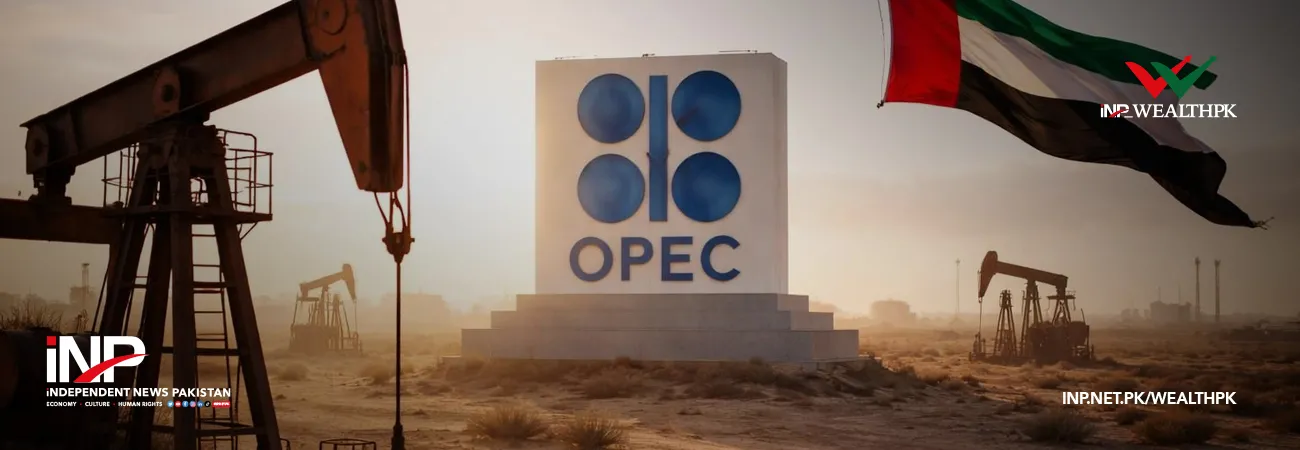
The United Arab Emirates’ decision to exit the Organization of the Petroleum Exporting Countries (OPEC) and the broader OPEC+ framework marks a significant moment for global energy markets, reflecting deeper structural and geopolitical shifts within the oil-producing bloc.
The development comes against the backdrop of heightened regional tensions linked to the ongoing Iran war, which has disrupted flows through the Strait of Hormuz — a critical route for nearly one-fifth of global oil supplies — and pushed Brent crude prices well above pre-conflict levels.
While Abu Dhabi has framed its move as part of a long-term production strategy, the decision appears to be rooted in a combination of policy divergence, evolving market priorities, and geopolitical recalibration.
Speaking with Wealth Pakistan, Amena Bakr, Head of Middle East & OPEC+ Insights at Kpler, said the UAE’s exit reflects a gradual buildup of tensions rather than a sudden shift.
Having closely followed OPEC developments for over a decade, she noted that dissatisfaction over production quotas had been visible since at least 2021, when the UAE challenged its assigned output limits after expanding its production capacity.
“The timing is particularly interesting, as markets are already adjusting to supply disruptions from the conflict, which may explain why the reaction to the UAE’s exit has been relatively contained,” she said.
Bakr suggested that the key question now is whether OPEC can continue to function as an effective mechanism for managing oil supply in an increasingly fragmented energy landscape.
She observed that although compromises were reached in the past, underlying tensions over quota allocations remained unresolved, particularly for producers investing heavily in expanding capacity.
According to her, recent regional developments — including disruptions around Hormuz and perceptions of limited alignment among Gulf states during the crisis — have added a political dimension to what is formally being described as a technical decision.
Imran Khan, a geopolitical analyst and Senior Fellow at the National Dialogue Forum, viewed the move as part of a broader realignment within the Gulf.
“The UAE’s interests are increasingly diverging from those of Saudi Arabia and other regional actors, prompting it to adopt a more independent policy direction,” he said.
He pointed to multiple areas of friction, including differing positions in regional conflicts such as Sudan, as indicators of a widening gap between traditional allies.
From a market perspective, Khan noted that the immediate impact of the UAE’s exit appears limited, as oil prices are currently being driven primarily by supply disruptions linked to Hormuz rather than structural shifts within OPEC.
He also highlighted that OPEC’s share of global oil production has declined over time, while non-OPEC producers — particularly the United States — have expanded output significantly, reducing the cartel’s relative influence.
Wajid Islam, Research Economist at the Pakistan Institute of Development Economics, said the UAE’s move underscores a broader trend of producers reassessing their strategic priorities in a changing energy environment.
He noted that while the short-term impact on markets may remain modest, the longer-term implications could be more significant if other producers begin to seek greater flexibility outside coordinated production frameworks.
“OPEC’s ability to maintain cohesion will be tested if more countries prioritize maximizing their individual production capacity,” he said.
In this context, the UAE’s exit may be less about a single decision and more about what it represents: a gradual shift toward a more decentralized and competitive global oil market.
While the full implications will unfold over time, the move highlights the growing complexity of energy geopolitics, where national strategies, market forces, and regional dynamics are increasingly converging.
Credit: INP-WealthPk
Related Articles