


i INP-WEALTHPK

Pakistan can restore deserts by adapting China’s land reclamation modelBreaking
March 03, 2026
By Azam Tariq
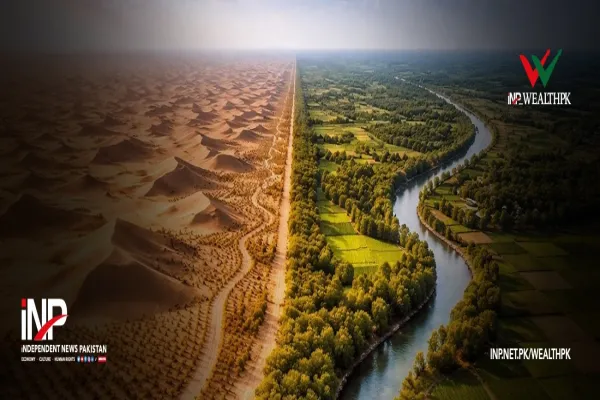
Pakistan can slow desertification and turn vulnerable drylands into productive landscapes by adopting practical, science-led measures inspired by China’s long-running land restoration campaigns. According to the United Nations Development Programme (UNDP), nearly 3.25 percent of Pakistan’s land area is degraded, affecting over 38 million people. At the same time, almost 30 percent of the population faces recurring drought conditions, increasing pressure on agriculture, livestock and rural livelihoods.
Experts argue that reversing this trend requires moving beyond policy documents toward targeted field action, backed by financing, data and institutional coordination. Dr Muhammad Faisal Ali, Assistant Professor focusing on climate change and agriculture at the Pakistan Institute of Development Economics (PIDE), believes Pakistan can convert existing cooperation frameworks into a focused desert-restoration strategy by leveraging platforms such as the China-Pakistan Economic Corridor (CPEC).
Talking to Wealth Pakistan, he suggested establishing joint demonstration sites in ecologically fragile zones such as Cholistan and Kharan to test drought-adapted plantation models, soil stabilisation methods and water-conservation techniques suited to Pakistan’s drylands. Technology-testing laboratories and structured training centres can support these efforts, he added. He said short, well-designed training attachments in China for Pakistani officials and field practitioners can help accelerate the adoption of proven techniques, provided they are supported by practical manuals tailored to local ecological conditions.
Dr Faisal also stressed the need to prioritise desertification-control schemes in federal and provincial development allocations. Stronger public financing, he said, will enable Pakistan to present credible, project-ready proposals for international climate funds. Aftab Mehmood, Conservator of Forests in Diamer, Gilgit-Baltistan, points to China’s sustained, science-driven campaigns against land degradation as an example of what long-term planning can achieve. He highlighted afforestation, sand-dune stabilisation and the use of drought- and heat-tolerant plant species as practical tools for Pakistan’s dry belts.
When combined with modern monitoring systems, these interventions can deliver measurable outcomes. He said under CPEC cooperation, Pakistan can benefit from Chinese expertise in GIS-based land tracking, remote sensing and climate-resilient plantation strategies. “Such tools will help authorities monitor vegetation cover, soil health and water availability in real time, ensuring that restoration efforts remain data-driven and accountable,” he added. Aftab said China’s recent push to share techniques developed in regions such as Ningxia adds a regional dimension to this cooperation.
Applying tested soil and water stabilisation methods in Pakistan’s desert zones could strengthen cross-border knowledge transfer, he added. Talha Tufail Bhatti, Assistant Research Officer at the Institute of Regional Studies (IRS), Islamabad, told Wealth Pakistan that Pakistan’s lack of reliable and accessible land data makes it difficult to identify degradation hotspots, measure progress and hold implementing agencies accountable. In contrast, he observed that China’s stronger policy follow-through is supported by coordinated execution structures.
He regretted that Pakistan’s National Action Programme to Combat Desertification has largely remained on paper instead of translating into sustained field implementation. He also pointed to inter-provincial canal disputes and falling groundwater levels as factors that can accelerate land degradation and complicate coordinated planning. While welcoming experience from China, Bhatti stressed that Pakistan must blend international best practices with indigenous agricultural knowledge to ensure that restoration measures remain socially accepted and locally relevant.
Experts agree that Pakistan’s desert restoration drive must rest on three pillars: targeted pilot projects, reliable data systems and stronger inter-institutional coordination. By aligning public financing, scientific expertise and community incentives — while deepening practical cooperation with China — Pakistan can gradually stabilise degraded lands, improve soil and water management, and strengthen rural resilience. If implemented effectively, such a strategy could transform vulnerable deserts into greener, climate-resilient ecosystems that support agriculture, livestock and long-term water security, helping safeguard both livelihoods and national environmental stability.
Credit: INP-WealthPk
Related News