


i INP-WEALTHPK

Pharma, textiles drive Pakistan-Kyrgyzstan trade expansionBreaking
September 21, 2026
By Azam Tariq
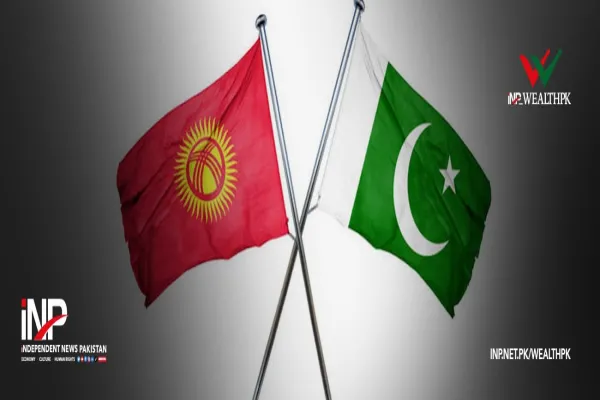
Pharmaceuticals and textiles are emerging as the strongest near-term sectors for expanding Pakistan-Kyrgyzstan trade, with economists also identifying agriculture and commercially viable joint ventures as important avenues for turning the two countries’ $200 million trade ambition into sustained business flows.
The assessment comes as Pakistan and Kyrgyzstan seek to substantially expand economic engagement from a relatively small trade base following Prime Minister Shehbaz Sharif’s September 2 visit to Bishkek.
A joint statement issued by Pakistan’s Ministry of Foreign Affairs said the two governments would prepare and implement a comprehensive action plan to gradually increase trade to $200 million while promoting joint investment, industrial cooperation and business-to-business activity.
Official customs data illustrate the scale of the opportunity as well as the challenge. According to the Ministry of Foreign Affairs, citing Federal Board of Revenue data, bilateral merchandise trade stood at just $5.18 million in FY2024-25, comprising $4.85 million in Pakistani exports and $0.33 million in imports.
Economists say the $200 million trade ambition would therefore require a combination of sector-focused business development and improved connectivity, with pharmaceuticals, textiles, agriculture and other competitive products providing potential cargo while better transit arrangements reduce the cost and uncertainty of moving those goods.
They say commercially viable joint ventures and stronger private-sector participation are equally important in moving the relationship beyond government agreements towards sustained trade and investment flows between Pakistan and Kyrgyzstan.
Speaking to Wealth Pakistan, Hira Mehfooz, economist and researcher in development economics, trade and econometrics at the University of Wah, described the $200 million target as ambitious and said it is better viewed as a policy objective than a forecast.
She said reaching the target would require a substantial increase in commercial flows within a relatively short period, with businesses focusing on sectors where greater opportunities already exist.
Mehfooz identified textiles and garments, pharmaceuticals, agriculture and agro-processing, halal products, mining and digital technologies among the sectors with stronger potential.
Pakistan already possesses productive capacity in several of these industries, while Kyrgyzstan could provide businesses with access to wider Central Asian markets, she noted.
The official Pakistan-Kyrgyz joint statement identifies similar areas for deeper industrial and investment cooperation, including mining and processing, agriculture, food, textile and light industries, pharmaceuticals, halal products and digital technologies. It also places emphasis on joint ventures, local production and technology transfer.
Maryam Ayub, Research Economist at the Policy Research Institute of Market Economy (PRIME), told Wealth Pakistan that Pakistan needs to concentrate on sectors where it possesses a competitive advantage and where demand could be developed in the Kyrgyz market.
She identified pharmaceuticals as the clearest near-term opportunity, alongside textiles and apparel, rice and selected agricultural products.
Ayub said memorandums and government commitments would not by themselves generate the scale of trade expansion required from such a low base. Commercially competitive products, private-sector participation and sustained demand would be critical to increasing bilateral trade.
Beyond identifying products, economists said transport connectivity and trade facilitation would determine whether businesses could turn those opportunities into regular commercial flows.
Geography and logistics have historically constrained Pakistan’s economic engagement with Central Asia, Mehfooz said, making efficient transit arrangements particularly important.
Pakistan and Kyrgyzstan recently signed a Transit Trade Agreement and agreed to work towards reliable and economically efficient transport and logistics routes. The arrangement now provides a mechanism through which some of the longstanding connectivity constraints could be addressed.
The two countries have also agreed to simplify transport, customs and administrative procedures under the existing Quadrilateral Traffic in Transit Agreement (QTTA), remove operational obstacles to freight movement and make greater use of Pakistan’s seaports and multimodal transport links.
Mehfooz cautioned that agreements alone would not eliminate logistical constraints. Faster and more predictable customs procedures, improved border and transport infrastructure, efficient documentation and warehousing, and reliable transit arrangements would determine whether businesses experience meaningful reductions in transport time, uncertainty and transaction costs.
Ayub similarly said improved transit arrangements could reduce border-related trade costs through better documentation, customs procedures and freight movement, but would not by themselves overcome the structural disadvantages created by distance and limited physical connectivity.
She identified joint ventures as another potentially important route for expanding economic engagement, particularly where Pakistani businesses could establish production or distribution capacity in Kyrgyzstan rather than relying exclusively on exports from Pakistan.
Such investments, Ayub said, could improve access not only to the Kyrgyz market but also to surrounding regional economies, helping make commercial cooperation more sustainable.
Credit: INP-WealthPk
Related News