i NEWS PAK-CHINA
Pak-China Mineral Cooperation to transform Pakistan’s Mineral Sector: ReportBreaking
January 29, 2026
Pakistan has invited China to invest in copper, gold, rare earth elements, according to a report published by Gwadar Pro, quoting Federal Minister for Planning Ahsan Iqbal.
Chinese Ambassador Jiang Zaidong said Pakistan is “rich in mineral resources” and stressed the importance of enterprise-led cooperation for sustainable development.
Referring to the new phase of CPEC 2.0, he encouraged Chinese companies to take a leading role in bilateral projects while helping strengthen local technical capacity.
Citing the Saindak project as an example, he noted that more than 5,200 Pakistani professionals have been trained, gaining valuable technical and managerial skills, reflecting China’s commitment to human resource development alongside mineral cooperation.
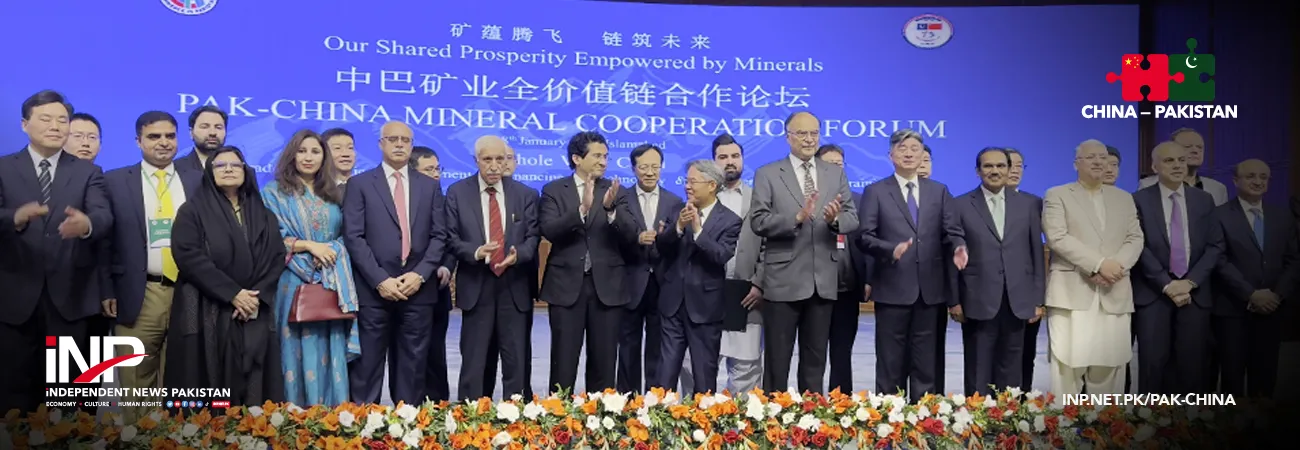
With the slogan “Our Shared Prosperity Empowered by Minerals,” the Pak-China Mineral Cooperation Forum was officially launched here at Jinnah Convention Center, in the presence of senior government officials and leading companies from both countries, marking a new chapter in bilateral collaboration in Pakistan’s mineral sector.
“It is a great honour and privileged for me to launch Pak-China mineral cooperation forum,” said the Ministe who was chief guest of the occasion.
“Pakistan invites China to invest in copper, gold, rare earth elements and other critical minerals so that our mineral wealth can be transformed into industrial strength, export competitiveness and shared prosperity,” Iqbal said.
“The mineral sector holds a central place in Uraan Pakistan for achieving our export targets. Pakistan’s mineral resources are valued at nearly six to seven trillion dollars, yet our current mineral exports stand at only about two billion dollars annually,” he said.
Ahsan Iqbal said that it was time to take Pak-China mineral cooperation beyond extraction towards value addition, processing, smelting and refining. Projects such as Saindak copper-gold, Duddar lead-zinc and Thar coal are successful examples of this collaboration.
He said, “More than 90 percent of Pakistan’s mineral exports are currently raw or semi-processed, which means value, jobs and technology leave the country with the raw material. Under Uraan Pakistan, this situation must and will change.”
According to Ahsan Iqbal their goal was to “establish mineral processing plants, smelters, refining facilities and mineral-based industrial clusters linked with special economic zones, moving decisively from extraction to value addition,”
He said, “China’s role is pivotal in transforming Pakistan’s mineral economy, as Chinese companies possess advanced expertise across the entire mineral value chain, from geological surveys to processing, smelting, refining and project financing.”
Federal Minister for the Board of Investment Qaiser Ahmed Sheikh said, “I have personally witnessed China’s development over the past 54 years and its consistent growth. Pakistan and China are ironclad friends with deep-rooted relations, and we have much to learn from China.”
Minister for Energy Ali Pervez Malik, in his keynote address, said that Pakistan and China have built a “rock-solid partnership defined by foresight, trust and long-term cooperation.”
Highlighting China’s global leadership in copper smelting and refining facilities, he said this experience offers “valuable lessons for emerging mineral economies like Pakistan.”
“I am pleased to note that Pak-China cooperation in the mining sector already has a solid foundation,” he said, while thanking Chinese companies operating in Pakistan. Reaffirming the government’s commitment, Malik added, “We will work together to make these projects an example of Pakistan-China cooperation in the mineral sector.”
Credit: Independent News Pakistan (INP) — Pak-China
Related News