

i NEWS PAK-CHINA
Pakistan seeks closer cooperation with China on space research: Ahsan IqbalBreaking
November 28, 2026
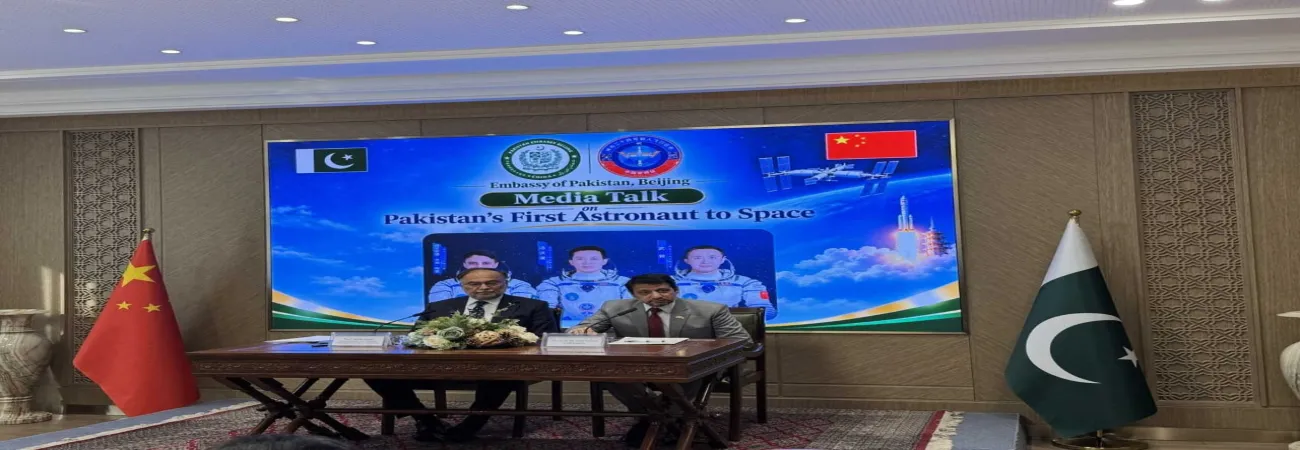
Pakistan wants to expand space cooperation with China to build its own research capabilities and use satellite technology in agriculture, water management and disaster preparedness, Ahsan Iqbal, minister for planning, development and special initiatives said.
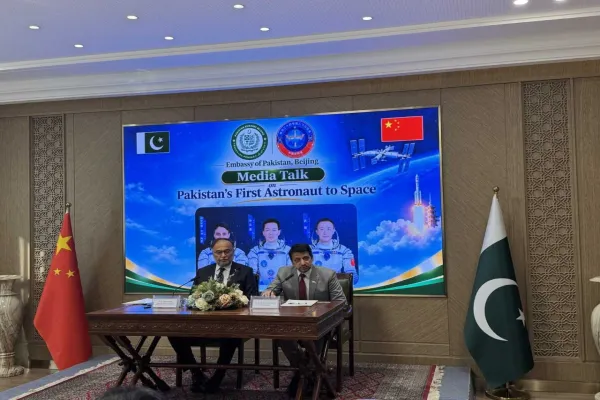
Speaking here at a press conference at the Embassy of Pakistan , Iqbal described the launch of the Shenzhou-24 mission carrying Pakistani astronaut Muhammad Zeeshan Ali as a milestone in scientific cooperation between the two countries.
According to China Economic Net, he thanked the Chinese leadership, the government and the China Manned Space Agency for giving Pakistan the opportunity to participate in China's crewed space programme.
He said Pakistan hoped to build on the mission through closer cooperation in space science and exploration.
"This is not the finish line; this is the beginning of a new partnership for us to advance space exploration," Iqbal said.
Iqbal recalled that the two countries had begun discussing the possibility of sending a Pakistani astronaut into space as early as 2017–2018.
Their earlier work together under the China-Pakistan Economic Corridor had focused on energy and transport infrastructure and had since expanded to fibre-optic connectivity, he said.
Iqbal said China's experience in satellite technology could help Pakistan prepare for natural disasters.
In a country vulnerable to climate change, he said, satellites could help authorities monitor environmental changes, develop early-warning systems and improve their ability to respond when disasters strike.
He also identified food security as a priority for cooperation. Pakistan needed crop varieties that could withstand adverse weather, more efficient irrigation practices and better ways to manage the water available to farmers, he said.
Iqbal said experiments that Ali would carry out during the mission, particularly those involving seeds and materials science, could provide information for researchers working in laboratories in Pakistan.
"Some of the experiments that he will perform will provide our scientists in their laboratories some critical information and insights into developing smart agriculture or developing seeds which are weather-resistant," he said.
He added that research into advanced materials could also support Pakistan's industrial development.
He said satellite monitoring and navigation could also help authorities plan agricultural production and manage water resources more efficiently. Other applications included urban development, logistics and connectivity.
Iqbal said Pakistan hoped to take part in a future lunar mission with China's support. Sending a rover to the Moon would allow Pakistani scientists to study the lunar surface and gain experience for the country's longer-term goal of achieving a lunar landing by 2035, he said.
The two countries were also discussing a knowledge corridor to train Pakistani researchers at leading Chinese universities.
Iqbal said the ambition was to train 10,000 Pakistani PhD scholars over the next decade in fields including artificial intelligence, space sciences, materials science, biotechnology, big data, automation and robotics.
He said the educational exchanges would help Pakistan train the scientists, researchers and technology professionals it would need to develop its own capabilities in these fields.
"Previously, we always said Pakistan-China friendship is higher than the Himalayas, but now we will say it is higher than the skies," he said.
Related News