


i NEWS PAK-CHINA

Students from Pakistan join a tour exploring cutting edge of China's green technologyBreaking
April 06, 2026
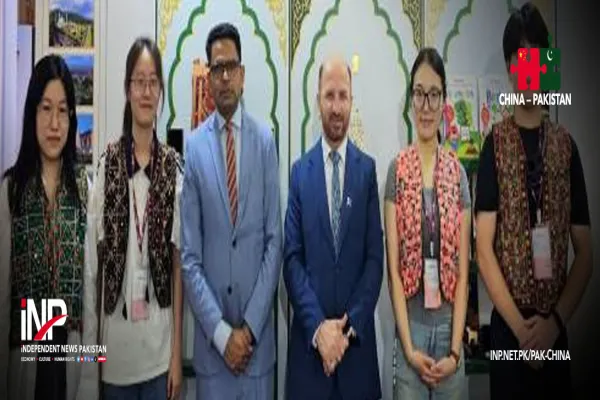
A group of 19 international students from six countries embarked on a journey of discovery on March 31, exploring the cutting edge of China's green technology, digital infrastructure and cultural heritage in a tour that offered them a window into the country's vision for the future.
Students from Pakistan, Indonesia, Cameroon, Zimbabwe, Russia and Morocco, are all active content creators on their social media platforms.
Studying at Nanjing Forestry University and Nanjing University of Information Science and Technology, they represent a growing community of international youth who are documenting their experiences in China and sharing them with audiences around the world.
Their itinerary took them through a range of sites in Nanjing's Xuanwu district that showcase the city's advances in technology and sustainability.
At the Jiangsu International Data Port, a provincial-level digital infrastructure hub, they witnessed the backbone of China's data economy—a network of high-capacity computing and storage facilities that enable everything from cross-border e-commerce to artificial intelligence development.
A visit to the Jiangsu Carbon Peak and Carbon Neutrality Construction Exhibition Center introduced them to the country's ambitious climate goals, where they learned about innovative technologies driving emissions reduction across industries, from green manufacturing to renewable energy integration.
The students also explored Hongshan Forest Zoo, an urban ecological preserve renowned for its conservation efforts and its beloved "internet-famous" animals, which have drawn millions of visitors and sparked widespread interest in wildlife protection.
A tour of the China Legal Industry Park offered insight into the country's legal services sector and its role in supporting innovation and business development.
At the Xuanwu Modeler Academy, they experienced firsthand new models of artificial intelligence talent cultivation, engaging with curricula designed to equip the next generation with skills in machine learning, data science and AI ethics.
A Tai Chi session provided a moment of connection with traditional Chinese culture, illustrating the harmony between heritage and modernity that characterizes China's development path.
For Urooj Rehmani, a PhD student in environmental ecology from Pakistan, the visit to the China Global Carbon Valley—a key feature of the carbon neutrality exhibition—was a profound inspiration.
"The most shocking, incredible thing for me is the use of technology in China as we can access each and everything at our doorstep," she shared.
"It really inspired me how technology combines environmental protection, bringing together companies to create projects and reduce carbon. Nanjing is going towards a greener future, and we are heading towards a protective future."
Danish Manzoor, a PhD student in meteorology also from Pakistan, found the experience deeply relevant to his academic research.
He was particularly struck by the AI models presented during the tour. "AI models—especially the iFlytek Spark Model—were very new for us. It was a great experience from a scientific perspective," he said, noting how such technologies are increasingly being applied to climate modeling and environmental monitoring.
Ishmael from Zimbabwe was equally enthusiastic about the intellectual exchanges throughout the day.
He described the experience as highly engaging and highlighted the value of cross-cultural dialogue and the opportunity to learn from China's approach to innovation and sustainability.
The tour also included participation in talent policy briefings, where these youth learned about employment and entrepreneurship opportunities in China, ranging from startup incubation programs to specialized recruitment initiatives for international graduates.
These sessions highlighted China's commitment to attracting global talent and integrating international students into its innovation ecosystem.
From discovering AI models that power green transitions to practicing Tai Chi in urban parks, these students are not merely observers but active participants in a country that increasingly serves as a meeting point for cultures, ideas and aspirations from around the world.
In the coming weeks, the participants will have the chance to continue their exploration with self-guided visits to iconic sites including the Purple Mountain Observatory, a century-old astronomical research facility, and the Deji Art Museum, a premier contemporary art space.
These visits will further deepen their connection to the city they now call home for their studies, enriching their understanding of both China's ancient heritage and its vibrant present.
Credit: Independent News Pakistan (INP) — Pak-China
Related News