

i NEWS PAK-CHINA
China, Pakistan sign Package of MoUs to deepen Industry Education Trainingتازترین
December 25, 2025
China and Pakistan on Tuesday signed a package of cooperation documents and launched joint programs to advance vocational education, with a focus on integrating industry needs with skills training, China Economic Net (CEN) reported on Thursday.
The agreements were announced at the "Seminar on International Cooperation and Exchange: Integration of Industry and Education in Vocational Education between China and Pakistan" held in Beijing.
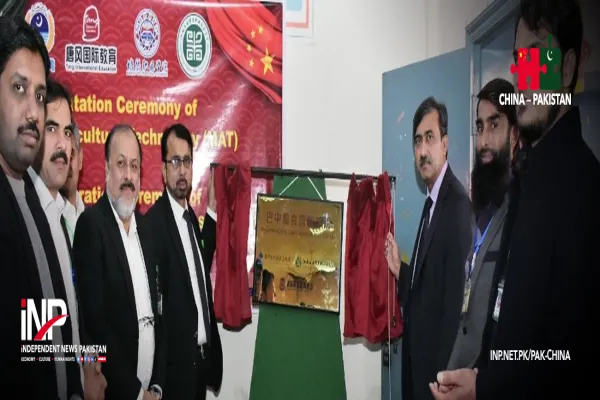
At the ceremony 21 items were signed and five cooperation platforms were unveiled, covering professional standards, shared teaching resources, faculty and curriculum development, and enterprise-linked training bases.
Under the Professional Standards and International Teaching Resource Database track, partners agreed to develop standards and resources in disciplines such as Culinary Arts & Nutrition, Fashion and Costume Design, Food Inspection and Testing, Supply Chain Operation, Fine Chemical Technology, Modern Agriculture Production, and Information Security Technology Applications, with participation from Pakistani authorities including NAVTTC and provincial technical education and training bodies.
A second set of Vocational Education "Brand Going Global" agreements established workshops and colleges aligned with priority sectors.
Examples include the Saishang Workshop in culinary training, a China–Pakistan Automotive Overseas Workshop for New Energy Vehicle Technology involving Hunan Automotive Engineering Vocational University, NAVTTC, and MG JW Automobile Pakistan Limited, and the Kaiwu Workshop in HVAC training with Heilongjiang College of Construction and corporate partners.
A three-party MoU on short-term training and digitalized courses was also signed by PVTC, ITMC, and UNI Services International.
Speaking at the seminar, Pakistan's Ambassador to China, Khalil Hashmi noted that cooperation has "moved beyond conceptual discussions" and entered "a new phase of practical advancement," adding that "vocational education has the ingredients to transform the dreams of young people into jobs, skills and employment." NAVTTC Executive Director Muhammad Aamir Jan emphasized building a scalable workforce for CPEC/BRI projects and industrial zones, expanding cooperation from conventional trades into areas such as manufacturing, digital technologies, energy and modern services.
Max Ma of ITMC Technology Co., Ltd. said that by sharing knowledge, skills, and achievements, the company aims to help Pakistani youth benefit in meaningful ways—using education to transform their prospects and build better lives.
He added that ITMC's steadfast commitment to "doing the right things, even when they are difficult" has kept the company firmly on course in supporting young people to pursue and realize their dreams.
Credit: Independent News Pakistan (INP) — Pak-China
متعلقہ خبریں