INP-WealthPk

Car-first culture in Pakistani cities fuels severe traffic congestion
May 11, 2026
By Muhammad Luqman
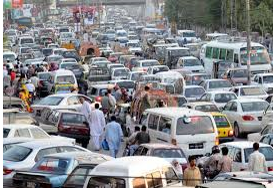
Traffic jams have become a routine feature on Lahore’s roads, particularly during morning and afternoon rush hours when offices and schools open and close. Long queues of vehicles often bring movement to a near standstill, with a river of cars of all sizes inching forward, engines idling, and horns creating an unbroken wall of noise.
Urban affairs experts attribute this growing congestion primarily to the excessive number of private vehicles competing for limited road space. This issue is compounded by public transport systems that have historically been underfunded, poorly regulated, and widely undervalued. As urban populations continue to expand and car ownership becomes increasingly aspirational, the problem is intensifying.
According to the Excise and Taxation Department, Lahore has approximately 7.5 million registered vehicles. Of these, around 1.7 million are cars and 5.3 million are motorcycles, in addition to thousands of rickshaws.
As of late 2025, Lahore’s public transport system has seen some expansion. The fleet includes around 70 electric buses and more than 650 TransLahore buses operating across the city and its suburbs. The core Metrobus system runs 64 articulated buses, complemented by the Orange Line Metro Train.
However, experts believe these measures fall short of actual demand.
“The limited number of buses, coupled with people’s preference for private vehicles, is a major cause of the persistent gridlock in cities like Lahore,” said Dr Nasir Javed, former chief executive officer of the Punjab Urban Unit.
In an interview with Wealth Pakistan, he noted that a single-occupancy car uses eight to 10 times more road space per passenger than a standard urban bus. “That ratio alone explains why Lahore and Karachi, despite years of road widening and flyover construction, remain perpetually congested,” he said.
He further highlighted the concept of “induced demand,” explaining that “The more lanes you build, the more cars arrive to fill them.”
Dr Javed added that the dominance of private vehicles in major Pakistani cities stems from a mix of aspiration, necessity, and institutional shortcomings. Public buses, where available, are often unreliable and overcrowded.
“For those who can afford a motorcycle—or increasingly, a car—the rational choice is to stop relying on public transport. But when many individuals make that choice, the collective outcome is deeply inefficient: cities operating far below their economic potential, choked by the very vehicles people depend on,” he said.
Transport specialists argue that expanding bus networks could significantly ease congestion, provided certain conditions are met. Shifting commuters from private cars to buses would also help reduce Pakistan’s petroleum import bill.
A typical car carrying an average of 1.5 passengers consumes six to eight litres of fuel per 100 kilometres. In contrast, a bus carrying around 50 passengers distributes fuel consumption far more efficiently, offering significantly lower energy use per passenger-kilometre.
“However, buses alone are not a complete solution. There is also a need for a policy shift,” said Dr Syed Murtaza Asghar Bukhari, Chief Executive Officer of TransPeshawar.
Talking to Wealth Pakistan, he emphasised that public transport must be supported by safe pedestrian infrastructure to enable commuters to access bus systems easily.
He added that high-capacity solutions such as Bus Rapid Transit (BRT) systems can move significantly more people using less road space. “But buses only deliver results when supported by dedicated lanes, reliable operations, and integrated networks. Otherwise, they risk becoming part of the congestion problem,” he noted.
Dr Bukhari also pointed to carpooling as a viable complementary measure. “Increasing vehicle occupancy, even marginally, can help reduce the number of cars on the road and ease congestion,” he said.
He stressed that neither buses nor carpooling alone can resolve the issue. “They must be part of a broader strategy that includes sustained public transport investment, demand management, and improved urban planning. The goal should be to move more people efficiently, not more vehicles.”
He further recommended the adoption of ICT-based systems such as ANPR cameras, e-challans, and intelligent traffic signals to ensure transparent and consistent enforcement of traffic regulations.
Credit: INP-WealthPk
Related Articles