


INP-WealthPk
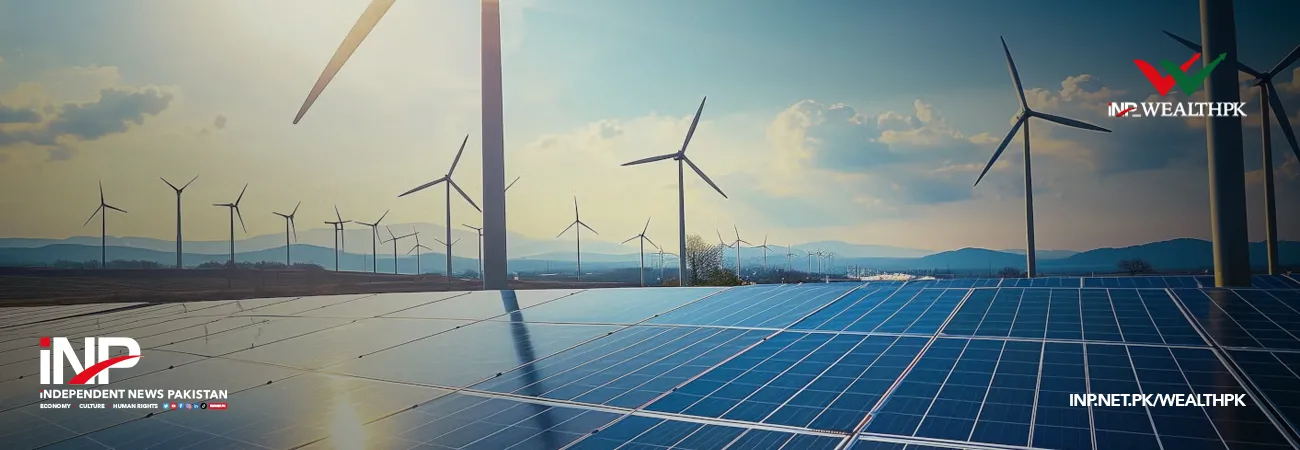
Pakistan can accelerate renewable transition through China's integrated energy model
August 11, 2026
By Azam Tariq
Pakistan can accelerate its renewable-energy transition by adopting an integrated approach to energy planning, which links electricity generation with transmission, storage, manufacturing and financing under a unified long-term strategy, experts say.
China's renewable-energy plan for 2026-2030 provides a useful reference for such an approach. Jointly issued by the National Development and Reform Commission and the National Energy Administration, the plan targets around 3.5 billion kilowatts of renewable generation capacity and approximately six trillion kilowatt-hours of annual renewable electricity by 2030, including more than 2.8 billion kilowatts of wind and solar capacity.
Pakistan's renewable-energy transition has followed a different path. Driven largely by high electricity tariffs, households and businesses have imported an estimated 16-17 gigawatts of solar panels in each of the past two years, making Pakistan one of the world's largest solar markets without a coordinated national renewable-energy programme. Experts believe the next phase should connect this rapid bottom-up expansion with long-term government planning.
Speaking to Wealth Pakistan, Federal Minister for Power Sardar Awais Ahmad Khan Leghari said Pakistan's heavy reliance on fossil fuels has left the economy vulnerable to global conflicts, supply disruptions and volatile international energy prices.
"Every additional unit of electricity generated from renewable sources reduces external dependence and strengthens Pakistan's energy sovereignty," he said.
Leghari said that while households, farmers and businesses initially drove Pakistan's renewable-energy transition through widespread solar adoption, the next phase requires coordinated government planning and stronger institutional integration.
He noted that energy policymaking has historically remained fragmented across the power, petroleum, water resources and other sectors. To address this, the government is preparing an integrated national energy policy, which is expected to be completed by June 2027.
The minister also stressed that renewable-energy development should extend beyond electricity generation to include battery storage and domestic battery manufacturing.
He said expanding these sectors would improve grid reliability, strengthen local industrial capacity and gradually reduce Pakistan's dependence on imported petroleum products.
Speaking to Wealth Pakistan, Wang Xiaojun (Tom), Founder and Executive Director of People of Asia for Climate Solutions, said China's experience demonstrates the importance of sustained policy coordination rather than isolated renewable-energy projects.
He said China began developing an integrated energy strategy in 2005, providing long-term policy certainty for public institutions, investors and financial institutions.
According to Wang, a credible integrated energy policy would also improve Pakistan's access to Chinese investment and financing by providing greater confidence that projects are aligned with a clear national development strategy.
He added that the strong bilateral relationship between Pakistan and China creates opportunities to expand cooperation in renewable technologies, manufacturing, investment and clean-energy supply chains.
Zainab Baber, an energy researcher at the Sustainable Development Policy Institute (SDPI), told Wealth Pakistan that selected coal-fired power plants could be converted to operate with renewable-energy technologies instead of being retired altogether.
She said SDPI plans to undertake a feasibility study on such conversions, describing the approach as one practical option for diversifying Pakistan's energy mix while making productive use of existing infrastructure.
Sharing a similar view, Amina Shahab, an energy-transition researcher at the Policy Research Institute for Equitable Development, said solar photovoltaic systems integrated with Battery Energy Storage Systems (BESS) currently offer Pakistan the most practical and scalable renewable-energy solution because solar resources are widely available and projects can be deployed relatively quickly.
She said wind and hydropower should continue to form part of Pakistan's future energy mix, although wind generation requires balancing support while large hydropower projects involve substantial investment, longer construction periods and careful management of seasonal water availability.
Shahab said Pakistan should align stable renewable-energy targets with the Integrated Generation Capacity Expansion Plan (IGCEP), modernise transmission infrastructure, connect renewable-rich regions to the national grid and invest in smart grids, battery storage and greater system flexibility.
She also called on regulators to ensure that future electricity planning incorporates renewable energy, storage technologies and grid flexibility from the outset.
According to Shahab, blended finance, green bonds and concessional climate funding can help reduce financing barriers, while transparent procurement, streamlined approvals and reforms under the Competitive Trading Bilateral Contract Market (CTBCM) can encourage greater private-sector investment.
She added that cooperation under the China-Pakistan Economic Corridor (CPEC) 2.0 offers opportunities to expand battery storage, electric mobility, clean-energy supply chains and private investment, provided projects are implemented within a transparent and consistent national policy framework.
The experts agree that Pakistan's renewable-energy transition will depend less on isolated projects and more on a coordinated national strategy linking policy, infrastructure, regulation, finance and industry. China's experience shows how long-term planning can guide investment and technology, while Pakistan's rapid solar adoption provides a strong foundation for building a more secure, reliable and sustainable energy system.
Credit: INP-WealthPk
Related Articles