


INP-WealthPk
Traditional textile exports fall 7% to $2.28bn, dragging overall industry growth
May 11, 2026
By Moaaz Manzoor
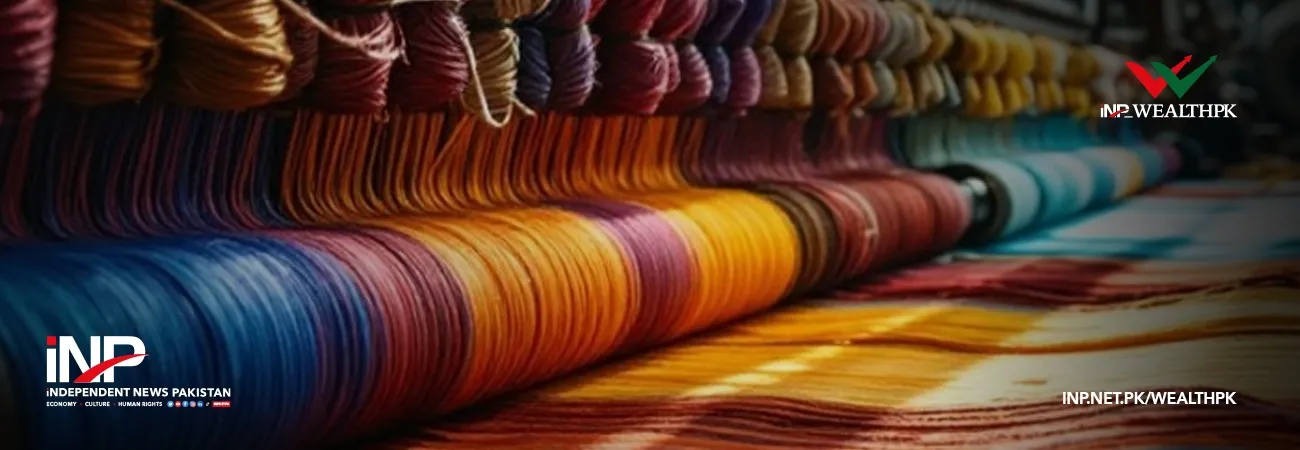
Pakistan’s traditional textile exports declined by 7% to $2.284 billion during July–March FY26 compared to $2.450 billion in the same period last year, as per the Pakistan Textile Council’s monthly export analysis report available with Wealth Pakistan. The data shows that traditional textile segments, covering chapters 50–60, continued to face downward pressure during the period under review, contributing to the overall slowdown in the country’s textile export performance.
Within this category, cotton remained the largest component but recorded a decline, with exports falling to $1,867.9 million from $1,988.8 million in the corresponding period of FY25. Similarly, man-made filaments exports dropped significantly to $40.7 million from $54.0 million. Exports of knitted or crocheted fabrics also declined notably, falling to $25.2 million compared to $34.5 million in the same period last year. Carpets and other textile floor coverings recorded a decrease to $37.0 million from $42.3 million.
Other categories also showed contraction, including wadding and felt products, which declined to $7.1 million from $8.9 million, and man-made staple fibers, which decreased to $258.4 million from $278.6 million. Vegetable textile fibers and paper yarn exports also fell during the period. However, a few segments within traditional textiles recorded growth. Special woven fabrics increased to $35.7 million from $29.3 million, while wool and related products rose slightly to $1.6 million from $1.5 million. In March 2026, traditional textile exports were recorded at $247 million, reflecting a 4% decline compared to $258 million in March 2025.
On a month-on-month basis, exports decreased by 1% from $250 million in February 2026. A longer-term trend indicates a continued decline in traditional textile exports over recent years. Exports in this category fell from $3,322 million in 2021–22 to $2,284 million in the current fiscal period, showing a consistent downward trajectory. The data highlights that despite minor gains in selected sub-categories, the overall performance of traditional textile segments remains under pressure, contributing to the broader slowdown in the textile sector during the period under review.
Credit: INP-WealthPk
Related Articles