i NEWS PAK-CHINA
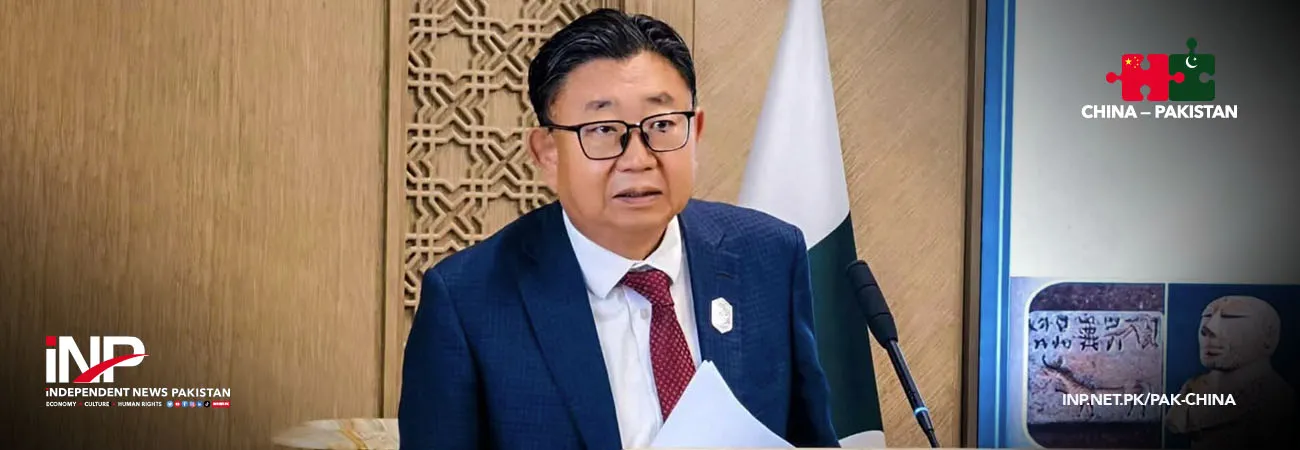
Chinese scholar on a journey into Indus Valley history, moved by academic exchanges between China and PakistanBreaking
September 18, 2026
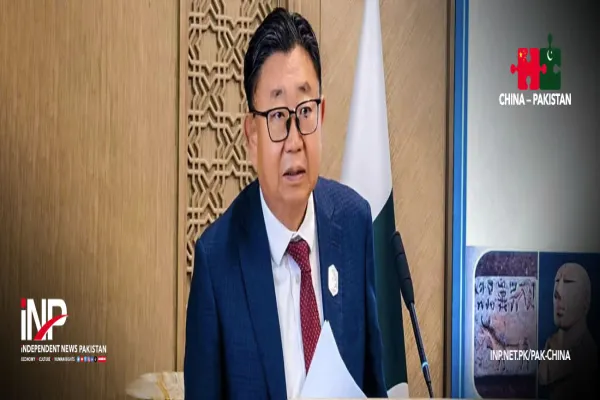
The research journey of Zhou Yushu, president of Inner Mongolia Honder College of Arts and Sciences, began with an object small enough to fit in the palm of a hand.
In 2021, Zhou came across an ancient Indus Valley seal at Honder College's North China Rock Art Research Institute.
The symbols carved into it reminded him of prehistoric rock-art symbols associated with China's Hongshan culture, China Economic Net (CEN) reported on Friday.
For Zhou, who had spent years studying the origins of Chinese writing, the encounter raised a question that would draw him into a new field of research: Could similarities between symbols from two ancient civilizations, separated by thousands of kilometers, offer clues to their shared past?
"I have always been interested in the origins of Chinese characters," Zhou said in an interview with CEN.
Oracle bone inscriptions, he noted, already represented a mature writing system.
That suggested to him that Chinese writing must have gone through a much longer process of formation and evolution before the appearance of those inscriptions.
He began applying approaches he had used in studying prehistorical Chinese rock and pottery symbols to the seals of the Indus Valley.
The more he looked, the more questions emerged. Following the symbols
Zhou and his research team eventually examined 401 relatively complete seals and interpreted 132 individual characters, grouping them into 10 thematic categories.
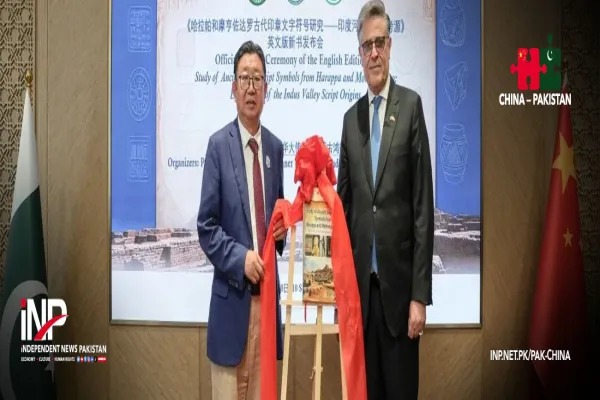
The research later became the basis of his book, Study of Ancient Seal Script Symbols from Harappa and Mohenjo-daro: Exploration of the Indus Valley Script Origins, bringing together the team's work on the symbols and their possible cultural connections.
But for Zhou, the research is about more than interpreting individual symbols. He sees recurring themes involving ancestors, fertility, natural phenomena, rituals, animal worship and everyday life in both the Indus Valley material and prehistorical Chinese cultures.
Among the findings that particularly interested him were symbols he interprets as references to ancient waterways, a thunder deity, and ancestor and fertility imagery.
The comparisons have led Zhou to propose a broader hypothesis: that some prehistorical populations may have moved westward from areas of present-day China through routes including the Karakoram Corridor and reached the Indus Valley, with possible links extending farther west.
Zhou stresses, however, that the proposed migration and cultural-transmission scenario remains a research hypothesis and requires further archaeological evidence.
That uncertainty is part of what keeps the research open-ended. The decipherment of the Indus script remains a major challenge for scholars, Zhou said, while Pakistan still has many seals that have not been systematically studied.
Rather than presenting his research as a final answer, he hopes it can encourage further discussion and collaboration. "I hope this research can become a starting point for dialogue and joint exploration with colleagues in Pakistan and around the world," Zhou said.
A research journey that crossed borders: Zhou's connection with Pakistan predates his work on the Indus Valley.
In 2010, teachers and students at his college organized donations for people affected by floods in Pakistan.
A year later, a 25-member delegation from the college visited Pakistan at the invitation of the country's Foreign Ministry, visiting universities, museums and other institutions.
The relationship later expanded into academic cooperation with Pakistani universities, including the University of the Punjab.
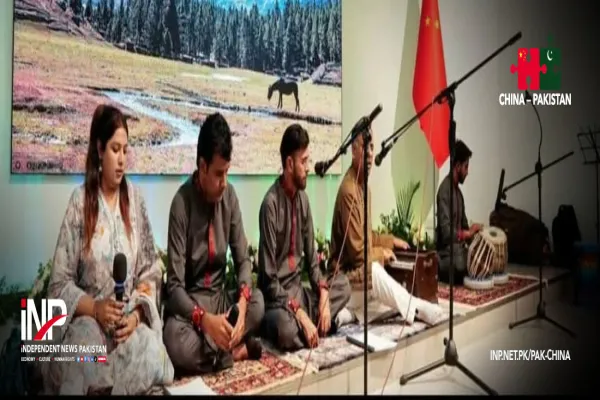
The two sides have held academic seminars and expanded exchanges involving universities, faculty, students and research.
More than a decade of exchanges gave Zhou opportunities to engage with Pakistani scholars and institutions. He said the experience provided a broader international perspective and created conditions for his research into the Indus Valley civilization.
The research, in turn, has become another channel for people-to-people exchange.
The English edition of Zhou's book is now available to international readers, while an Urdu translation has also been prepared for Pakistani audiences.
For Zhou, translation is more than a change of language. It is a way of bringing a research project that began in China into a wider academic conversation.
Recognition, and what comes next: The research has also brought Zhou an unexpected distinction.
The Government of Pakistan has decided to confer the Sitara-i-Quaid-i-Azam, a high-level civil award, on him for his contribution to China-Pakistan friendship and people-to-people exchanges.
Zhou regards the honor as recognition, but also as a responsibility to continue studying Pakistan.
For Zhou, the relationship with Pakistan is measured not only in academic papers or ceremonies, but in years of accumulated encounters.
He plans to continue research into Pakistan's history and culture through the college's Pakistan Research Center and to broaden the scope of his work.
The ancient seals, meanwhile, remain at the center of his questions. A symbol carved thousands of years ago cannot explain its own origins. Nor can one study settle the question of how ancient peoples moved, interacted or influenced one another.
For Zhou, that is precisely why the research should continue.
What began with a single seal has become an invitation to a much larger conversation --one involving archaeologists, historians and researchers across borders, and linking an unresolved question about the ancient world with academic exchanges taking place between China and Pakistan today.
Credit: Independent News Pakistan (INP) — Pak-China
Related News