i NEWS PAK-CHINA
Global competition in AI intensifying, spilled over into agricultureBreaking
March 05, 2026
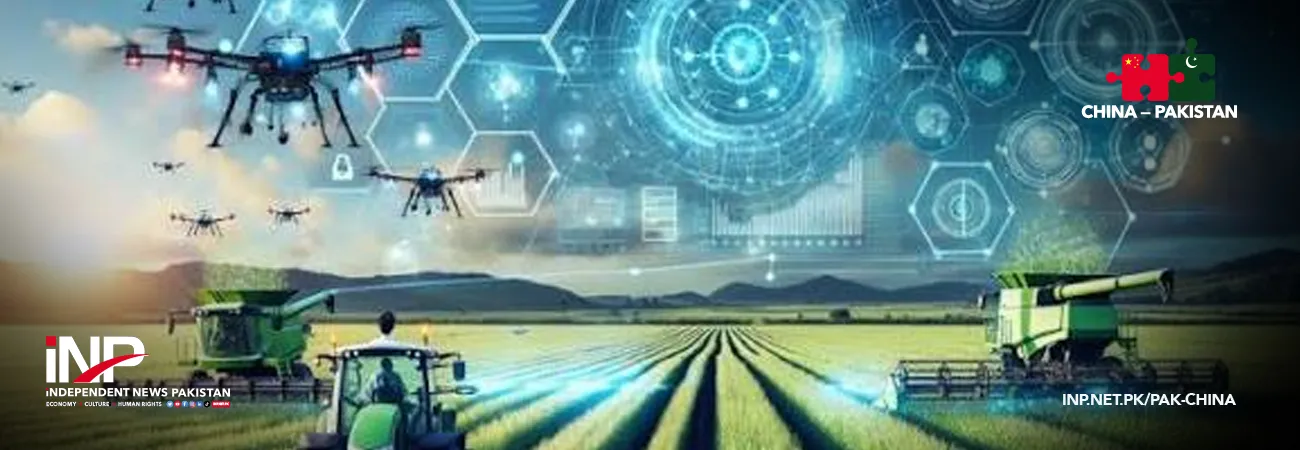
Global competition in artificial intelligence (AI) is intensifying at an unprecedented pace, and this fierce momentum has now spilled over into agriculture.
In 2025, the launch of a series of world-first breakthroughs has placed China at the forefront of multiple agricultural AI sectors, against the backdrop of its contribution rate of agricultural scientific and technological progress exceeding 64%.
A number of agriculture-specific large models were released intensively in China, forming a cluster covering multiple scenarios.
Among them, Fengdeng (SeedLLM), developed by China Agricultural University, Shanghai Artificial Intelligence Laboratory and Yazhou Bay National Laboratory, revolutionized breeding research by simulating researchers' complete workflow: independently proposing hypotheses, designing experiments, analyzing results and self-correcting.
It has successfully identified new functions of previously uncharacterized rice and corn genes with field-verified accuracy.
Since its launch in May 2025, it has been adopted by over 600 Chinese and foreign breeding institutions, including the International Rice Research Institute and the Indian Institute of Rice Research.
Complementing Fengdeng is GEAIR, the world's first full-process AI breeding robot developed by the Institute of Genetics and Developmental Biology (IGDB) of the Chinese Academy of Sciences (CAS).
Its breakthrough achievements were published in the top international journal Cell. GEAIR automates precision pollination and sampling, boosting efficiency by 12-fold and cutting costs by 60%, and together with Fengdeng form a fully closed-loop intelligent breeding system.
Beyond this groundbreaking breeding duo, China's agricultural AI cluster also includes Shennong Large Model 3.0, Nonggeng Large Model 1.0, Weichai Lovol Smart Agriculture AI Large Model, Fanli Large Model, as well as vertical models such as Fengshu for soybean breeding and Lixiang for the pear industry.
These specialized models, together with general ones like Tianquan, have been deployed in a coordinated manner to support intelligent decision-making in cultivated land monitoring, crop management and water-fertilizer regulation, well adapting to the refined management needs of China's 128 million hectares of cultivated land.
Unlike other major agricultural AI nations, whose systems are mainly designed for expensive, large-scale commercial farms, China has forged a distinct, transformative path. Rooted in original technological breakthroughs, featured by wide‑reaching inclusive applications, and centered on serving smallholder farmers, it has created an unparalleled competitive advantage.
The distinctive strengths of China's agricultural AI start with its outstanding scenario adaptability that directly meets the needs of smallholder farmers and hilly/mountainous regions. It fits fragmented plots, complex terrain and customary practices without requiring large-scale land transfer, and features low cost and user-friendly solutions.
AI-powered plant protection, precision irrigation and field monitoring have been widely applied in major grain-producing provinces, with field-verified practices nationwide such as AI-based wheat protection in Shandong, precision irrigation in Ningxia's saline-alkali land, and field monitoring in Heilongjiang's black soil.
China's agricultural large models have distinct regional characteristics, which are fully tailored to the specialized agricultural industries across the country, as noted by Wu De, President of Sichuan Agricultural University and Deputy to the 14th National People's Congress, in an exclusive interview with CEN.
Aside from adaptability, China leads the world in application scale. It ranks first globally in agricultural drone inventory, operation area and smart agricultural machinery deployment.
By 2025, China's fleet of agricultural drones had exceeded 300,000 units, with an annual operation area of over 30.67 million hectares — accounting for more than 60% of the world's total. More than 100,000 sets of agricultural machinery are equipped with Beidou autonomous driving systems, enabling centimeter-level precision operations.
AI-powered plant protection, precision irrigation and field monitoring have been widely deployed across major grain-producing provinces, covering tens of millions of hectares.
Its prominent cost-performance advantages further enhance its value, as comparable technical solutions cost only 1/3 to 1/2 of those in developed countries but achieve over 80% of the core functions, turning advanced agricultural technology from a luxury for large commercial farms into accessible tools for ordinary producers, which highly matches the needs of developing countries.
Complementing these strengths is a complete and independent technical system, whose unique "hardware + data + scenario" integration connects the entire space-air-ground-field chain: satellite remote sensing, drone patrols, smart machinery operations and field-based large-model decision-making, forming a closed loop far more practical than developed countries' fragmented, single-technology approaches.
Finally, China boasts world-leading efficiency in industry-university-research collaboration. Supported by strong policy-research-industry coordination, the world's largest agricultural research workforce, and a unified innovation system, it accelerates the transformation of scientific and technological achievements.
Today, China's agricultural AI is no longer just a solution for itself, but is gradually becoming a global public good serving world food security, especially vital for developing countries.
By opening up relevant technologies and solutions, China is narrowing the global agricultural digital divide through inclusive innovation, making agricultural modernization a realistic goal for more nations, rather than a privilege for the few.
Credit: Independent News Pakistan (INP) — Pak-China
Related News