


i NEWS PAK-CHINA
Pakistan's Panda Bond debut signals investor confidence in economic recoveryBreaking
May 18, 2026
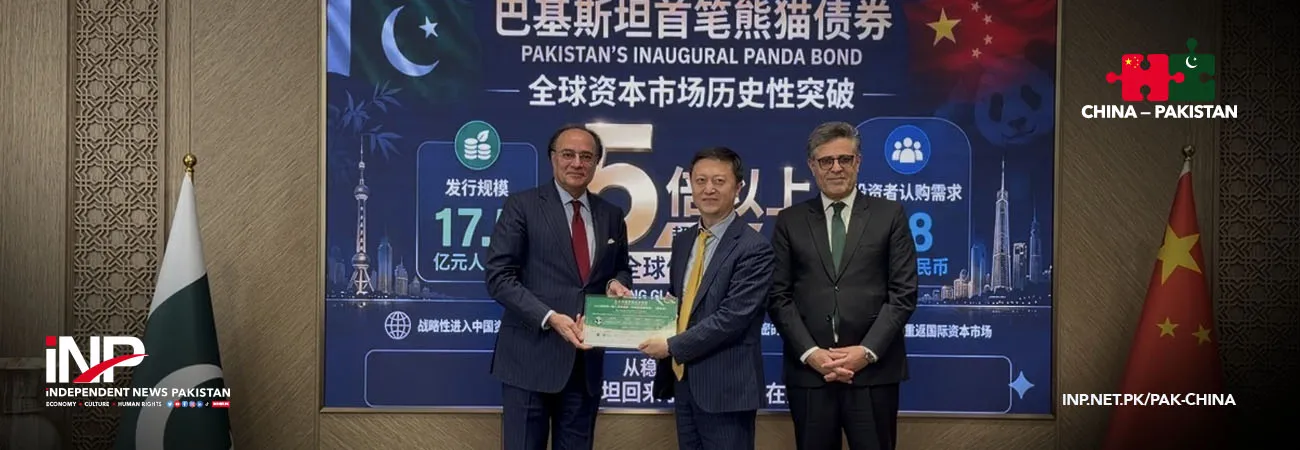
Pakistan has tapped China's onshore bond market for the first time, raising Rmb1.75bn in a closely watched panda bond that gives Islamabad a cheaper source of funding and offers Beijing a fresh test case for the international use of the renminbi.
The three-year bond, priced on May 14 and announced the following day, carries a coupon of 2.5 per cent and was more than five times subscribed, according to people involved in the transaction.
The deal, equivalent to roughly $250mn-$258mn, marks Pakistan's debut in China's domestic renminbi bond market, China Economic Net (CEN) reported on Monday.
For Pakistan, the appeal is straightforward. The country has long relied on dollar funding, Eurobonds and sukuk to meet part of its external financing needs.
But with dollar borrowing still costly and external debt pressures persistent, the panda bond offers a lower-cost alternative — not a replacement for dollar markets, but a useful addition to the sovereign funding toolkit.
Muhammad Aurangzeb, Pakistan's finance minister, said in an interview that the 2.5 per cent coupon was the lowest Pakistan had achieved on a sovereign bond. He described the transaction as "long overdue", noting that China is one of the world's largest and deepest capital markets.
"This is a hugely important diversification trade for us," he said, pointing to both the widening of Pakistan's investor base and the addition of renminbi funding to the country's borrowing mix. He added that the deal also supported the broader internationalisation of the Chinese currency.
The bond is the first tranche of a Rmb7.2bn panda bond programme approved for Pakistan. Aurangzeb said the initial Rmb1.75bn issue would not be a one-off transaction. Once the first bond settles, Pakistan plans to move quickly to launch the request-for-proposal process for the next tranche.
The deal was arranged by China International Capital Corporation, Bank of China, Standard Chartered and Hongta Securities. Standard Chartered was the only foreign bank among the joint lead underwriters.
A key feature of the transaction is its credit structure. The Asian Infrastructure Investment Bank and the Asian Development Bank provided a partial credit guarantee covering about 95 per cent of principal and interest, helping the bond secure a domestic AAA rating in China.
That structure matters because weaker sovereign borrowers have typically needed full guarantees to achieve the highest rating in China's domestic market.
The Pakistan deal suggests that multilateral development banks may be able to help emerging-market sovereigns access renminbi financing without relying on a fully wrapped structure.
The proceeds will be used for sustainable development projects, including water management, energy infrastructure and healthcare-related investments. That gives the bond a development-finance angle, rather than making it a general balance-of-payments instrument.
The transaction comes as China's panda bond market is growing quickly. Issuance reached Rmb88.24bn in the first quarter of 2026, roughly double the level of a year earlier, as foreign sovereigns, multilateral lenders and overseas companies have made greater use of China's domestic debt market.
For Chinese policymakers, the Pakistan bond is useful for two reasons. It brings another sovereign borrower into the onshore market, and it helps move the renminbi beyond its more familiar role as a trade settlement currency.
The currency is increasingly being tested in sovereign financing, infrastructure funding and institutional portfolio allocation.
For Pakistan, the deal arrives at a delicate but improving moment. The country has been working to stabilise its economy after years of balance-of-payments stress, high inflation and pressure on foreign exchange reserves.
Aurangzeb said reserves, the fiscal position and the currency were broadly moving in the right direction, though external shocks had complicated the outlook.
He said Pakistan's economy was likely to grow close to 4 per cent this fiscal year, below earlier expectations but still an improvement.
Inflation has eased, the current account has improved, and investors have become less concerned about near-term sovereign default risk. Pakistan's CDS-implied default probability fell sharply between June 2024 and September 2025, according to market data cited by officials.
Still, the country's financing needs remain substantial. Pakistan's external debt and liabilities stand at about $138bn, including roughly $92bn in external public debt.
Heavy dependence on dollar borrowing leaves the country exposed to US interest-rate cycles and exchange-rate swings, both of which can raise the local-currency cost of servicing external debt.
Renminbi borrowing does not remove those vulnerabilities. But it can help spread them. By adding a new currency and investor base, Pakistan can modestly diversify its debt profile and reduce some reliance on a single funding channel.
Aurangzeb also linked the bond to the broader financial relationship between China and Pakistan.
He said the share of bilateral trade settled in renminbi had risen from about 4-5 per cent several years ago to about 24 per cent. Existing swap arrangements with the People's Bank of China had helped support that shift, he said, adding that Pakistan hoped to expand the arrangement to facilitate more trade settlement in renminbi.
The bond also fits into the changing shape of the China-Pakistan Economic Corridor. The first phase of CPEC focused heavily on government-to-government infrastructure projects, including roads, ports and power plants.
Aurangzeb said the second phase would be more business-led, with greater emphasis on joint ventures in agriculture, information technology, artificial intelligence, minerals and mining.
That shift gives the panda bond a broader significance. If Pakistan can continue to issue in China's bond market, and if renminbi settlement, currency swaps and project financing become more closely connected, the country could build a more integrated renminbi funding channel for trade and investment with China.
There are limits to how far the symbolism should be pushed. One Rmb1.75bn bond will not transform Pakistan's debt position, nor will it alter the dominance of the dollar in emerging-market finance. The renminbi remains a supplementary currency for most sovereign borrowers, not a substitute for the dollar.
But as financing conditions diverge across major economies, even supplementary channels matter. For countries facing high dollar costs and recurring refinancing pressure, China's bond market may offer a useful additional option.
Pakistan's debut panda bond shows how that option can be structured — with multilateral support, a development-finance label and a pricing advantage large enough to attract attention.
For Beijing, the deal is a small but tangible step in expanding the financial use of its currency. For Islamabad, it is a cheaper borrowing exercise and a signal to investors that it is trying to broaden its financing base.
For other emerging economies, it may serve as an early example of how renminbi capital markets can be used not to escape the dollar system, but to make dependence on it a little less absolute.
Credit: Independent News Pakistan (INP) — Pak-China
Related News