



آئی این پی ویلتھ پی کے

China projects GDP growth of over 6 trillion yuan in 2026
March 14, 2026
By Special Correspondent
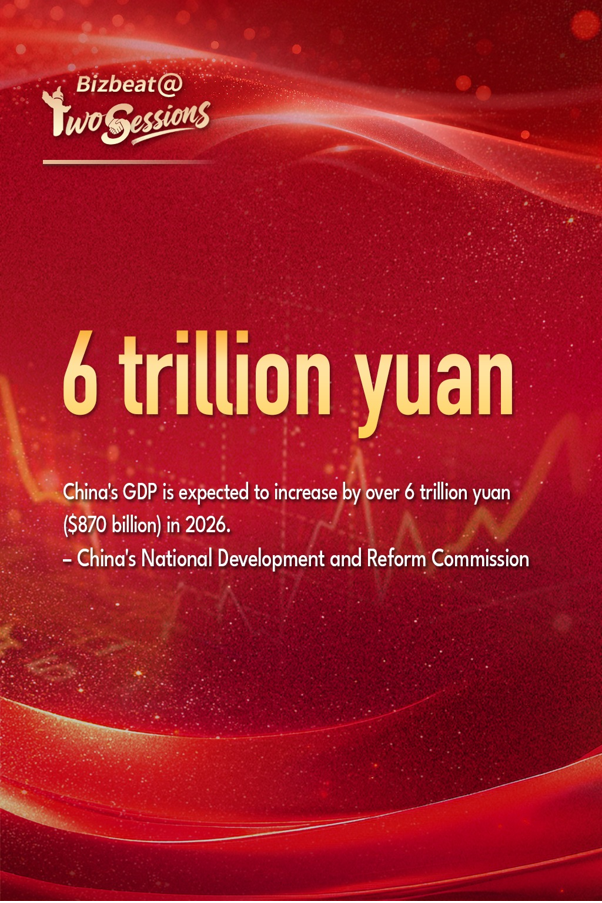
China’s gross domestic product (GDP) is expected to grow by more than 6 trillion yuan in 2026, providing strong support for employment, public well-being and risk prevention, according to the country’s top economic planner.
Zheng Shanjie, head of the National Development and Reform Commission (NDRC), shared the projection at a press conference held on the sidelines of the fourth session of the 14th National People’s Congress in Beijing.
The growth outlook comes as China sets a GDP growth target of 4.5 to 5 percent for the year, with policymakers pledging to strive for stronger results through coordinated macroeconomic policies. A combination of fiscal, monetary, investment, employment and consumption measures will be implemented to maintain stable economic expansion and support new growth drivers.
China’s fiscal expenditure, new government bond issuance and central government transfers to local authorities are all expected to reach record highs this year, according to Finance Minister Lan Fo’an.
The country’s total fiscal expenditure is projected to exceed 30 trillion yuan for the first time, while new government bond issuance is expected to reach a record 11.89 trillion yuan. Central government transfers to local governments are projected to rise to 10.42 trillion yuan to strengthen local fiscal capacity.
Large-scale investment is also expected to play an important role in supporting economic growth. Total investment in infrastructure, public services and other key sectors such as power grids, computing power, education and healthcare is expected to surpass 7 trillion yuan in 2026.
In addition to infrastructure spending, China plans to expand domestic demand and support private investment. The central government will allocate 100 billion yuan to implement coordinated fiscal and financial policies aimed at boosting consumer spending and encouraging private investment.
Another 250 billion yuan in ultra-long special treasury bonds will be used to support consumer goods trade-in programs as part of efforts to stimulate domestic consumption and strengthen the domestic market.
The government is also increasing support for technological innovation and industrial upgrading. Nearly 1.3 trillion yuan in fiscal funds will be allocated this year for science and technology development, representing an increase of 7.1 percent compared with the previous year.
China will continue to modernize its industrial system by promoting deeper integration of technological and industrial innovation and accelerating the development of new economic drivers.
Artificial intelligence is expected to play an important role in this transformation as the government advances its “AI Plus” initiative to expand the application of AI technologies across industries.
China is also promoting the development of emerging sectors such as integrated circuits, the low-altitude economy and intelligent robots. These industries, which had a combined value approaching 6 trillion yuan last year, are projected to exceed 10 trillion yuan by 2030.
Alongside growth and innovation policies, authorities are also working to promote balanced trade and expand global economic cooperation.
China plans to stabilize exports while expanding imports of agricultural products, premium consumer goods, advanced equipment and key components, according to officials.
The country will continue to expand market access and promote high-standard opening up, including further opening of the service sector and pilot programs in areas such as telecommunications services, biotechnology and wholly foreign-owned hospitals.
Authorities will improve market-stabilizing mechanisms and enhance risk monitoring across markets to prevent the transmission of financial risks.
China will also establish a national-level mergers and acquisitions fund this year to support venture capital investment and improve capital turnover efficiency. The fund is expected to guide and leverage more than 1 trillion yuan of investment from various sources.
Looking ahead, China expects its manufacturing and service sectors to generate more than 10 million jobs annually between 2026 and 2030, while the size of the country’s service sector is projected to exceed 100 trillion yuan during the same period.
These measures are aimed at strengthening economic resilience, promoting innovation-driven development and sharing more opportunities with the global economy.
Credit: INP-WealthPk
متعلقہ مضامین