


i INP-WEALTHPK

Russia rail connectivity offers Pakistan new gateway to Eurasian marketsBreaking
September 02, 2026
By Azam Tariq
Pakistan's proposed freight rail connectivity with Russia could provide wider access to Central Asian and Eurasian markets, create new transit business through Pakistani ports and strengthen the country's position as a regional trade gateway, experts say.
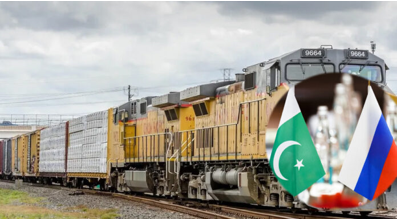
Pakistan and Russia are working on their first bilateral freight rail services linking Moscow with Karachi and Faisalabad, with both sides finalising arrangements and identifying companies interested in moving commercial cargo along the route.
Experts say the potential economic value of the connectivity extends beyond Pakistan-Russia bilateral trade, as the rail corridor could provide Pakistani exporters with greater access to Eurasian markets while allowing Pakistan to generate transit revenue from regional cargo flows.
The opportunity comes against a relatively limited bilateral trade base. State Bank of Pakistan data show Pakistan's receipts from exports to Russia stood at $41.57 million during July-April FY2026, compared with $58.63 million in the corresponding period a year earlier. Import payments from Russia were $45.03 million during July-May FY2026, against $173.01 million in the same period of FY2025.
Speaking to Wealth Pakistan, Rana Asif Khan, Founder and President of the International Road Transport Chamber, said improved railway connectivity could expand Pakistan's economic links beyond bilateral trade with Russia and strengthen its position as a transit route for the wider region.
"The proposed railway network between Karachi and Moscow is a good development," he said, adding that it could help fill gaps left by earlier regional rail connectivity initiatives and support economic activity across countries connected with the route.
Khan said Pakistan had also recently introduced a multimodal cargo system under which a single document could be used for different modes of transport, customs and clearance procedures, helping facilitate cross-border cargo movement and transport certification.
For Pakistan, he said, one of the major potential gains would be the ability to generate non-tax revenue from transit traffic originating from the Central Asian republics.
Stronger railway links could also increase freight traffic through Pakistan, expand opportunities for Pakistani exports to Central Asian markets and provide landlocked regional economies with greater access to Pakistani seaports, he added.
Hossein Norouz Fashkhami, Director of Market Development and Caspian-Eurasia Relations at Iran's Anzali Free Zone Organization, said the proposed connection should be viewed as part of a broader trade and logistics strategy rather than as a standalone railway project.
He said Pakistan's immediate opportunity was to strengthen its existing railway connection with Iran through the Taftan-Mirjaveh-Zahedan corridor and Main Line-3.
From there, Pakistani cargo could move through Iran's national railway network towards the Caspian Sea and then by sea to Russian Caspian ports such as Astrakhan and Makhachkala.
Such connectivity, he said, could provide Pakistan with an additional gateway to Russia and potentially Central Asian and wider Eurasian markets, particularly for agricultural and food products, textiles, pharmaceuticals, minerals and manufactured goods.
Fashkhami, however, said the existing Pakistan-Iran railway interface continued to pose important operational constraints.
Pakistan's rail network uses broad gauge, while Iran's main railway system operates on standard gauge, requiring transhipment or other operational arrangements at the border. This increases handling costs and weakens the competitiveness of rail freight.
He said the objective should therefore be to establish predictable cross-border freight operations with minimum handling, supported by agreed arrangements for wagon exchange, locomotive operations and cargo handling, as well as solutions to the break-of-gauge problem where technically feasible.
Customs facilitation and digitalisation would be equally important. Fashkhami said electronic documentation, pre-arrival customs information, cargo tracking and digital exchange of railway data could reduce delays that infrastructure investment alone could not address.
He also stressed that sufficient cargo would need to move in both directions for the railway service to remain commercially sustainable.
Fashkhami said the wider economic potential of the proposed connectivity would therefore depend on Pakistan combining improved railway infrastructure with efficient border procedures, competitive transit times and reliable two-way cargo flows.
Credit: INP-WealthPk
Related News