


INP-WealthPk
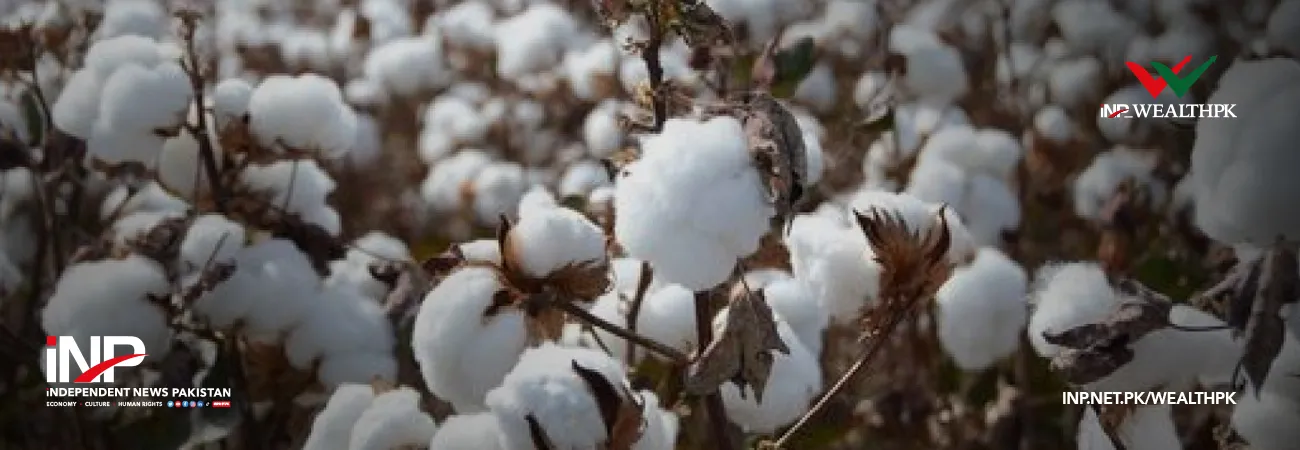
Cotton output misses FY25 national target
June 02, 2026
By Azeem Ahmed Khan
Pakistan’s cotton crop remained below national targets during FY2024-25, although Sindh delivered comparatively better performance in cultivation and production while Balochistan demonstrated strong yield efficiency, according to the Year Book 2024-25 released by the Ministry of National Food Security and Research.
The report showed that cotton cultivation covered 2.043 million hectares against a national target of 3.118 million hectares, achieving 66% of the sowing target. Cotton production reached 7.084 million bales against the target of 10.874 million bales, reflecting a 65% achievement level nationwide.
Punjab retained its position as the country’s largest cotton-producing province. Cotton cultivation in the province covered 1.304 million hectares—78% of the 1.680-million-hectare target.
However, production in Punjab remained significantly below expectations, with the province producing 3.838 million bales against a target of 6.500 million bales, translating into only 59% achievement.
Sindh emerged as the comparatively stronger performer among provinces, achieving 92% of its cultivation target with 0.582 million hectares under cotton against the planned area of 0.630 million hectares.
The province produced 2.823 million bales against a target of 3.900 million bales, recording 72% achievement in production and outperforming other provinces in overall target attainment.
Balochistan demonstrated strong productivity despite limited cultivation area. Cotton cultivation in the province covered 0.157 million hectares against the target of 0.808 million hectares. However, production reached 0.423 million bales against a target of 0.473 million bales, translating into an 89% achievement rate.
The report noted that Balochistan’s higher yield efficiency helped partly offset wider national production shortfalls.
Khyber Pakhtunkhwa continued to play a relatively minor role in cotton production. Cotton cultivation covered only 0.000045 million hectares against the target of 0.00030 million hectares, while production stood at 0.00036 million bales against the target of 0.00093 million bales.
The report stated that while Sindh showed relatively stronger performance in both cultivated area and production, it still remained below planned targets. Punjab remained the backbone of Pakistan’s cotton economy, but its production performance lagged despite achieving a significant portion of its cultivation target.
The report also highlighted relative stability in cotton prices during the FY2024-25 season.
National average seed cotton (phutti) prices stood at Rs8,138 per 40kg, ranging from Rs7,543 per 40kg in August 2024 to Rs8,538 per 40kg in February 2025.
Punjab recorded the highest annual average seed cotton price at Rs8,576 per 40kg, with prices peaking at Rs9,400 during February 2025.
Sindh posted an annual average price of Rs7,701 per 40kg, with prices ranging between Rs7,269 in January 2025 and Rs8,821 during October-November.
Meanwhile, the average lint price during the season stood at Rs18,994 per 40kg. Prices reached their highest level of Rs19,743 in September 2024 before easing to Rs18,230 in December. Lint prices later rebounded to Rs19,553 in January 2025 before softening again to Rs18,331 in March.
According to the report, cotton price movements reflected active demand from textile mills, seasonal supply patterns and changing trends in global cotton markets.
The report further highlighted the continued role of the Central Cotton Research Institute (CCRI), Multan, in strengthening research and development in the sector.
Established in 1970 under the Pakistan Central Cotton Committee, the institute has completed more than five decades of research in agronomy, plant breeding and genetics, entomology, plant pathology, fibre technology and technology transfer.
The institute has developed 38 elite cotton varieties since its inception, with research focused on improving early maturity, heat and drought tolerance, disease resistance and fibre quality characteristics.
CCRI Multan is also providing education, technical support and training to researchers, extension workers, students and cotton growers while promoting mechanization and production technologies across cotton-growing regions of the country.
Credit: INP-WealthPk
Related Articles