



i NEWS PAK-CHINA
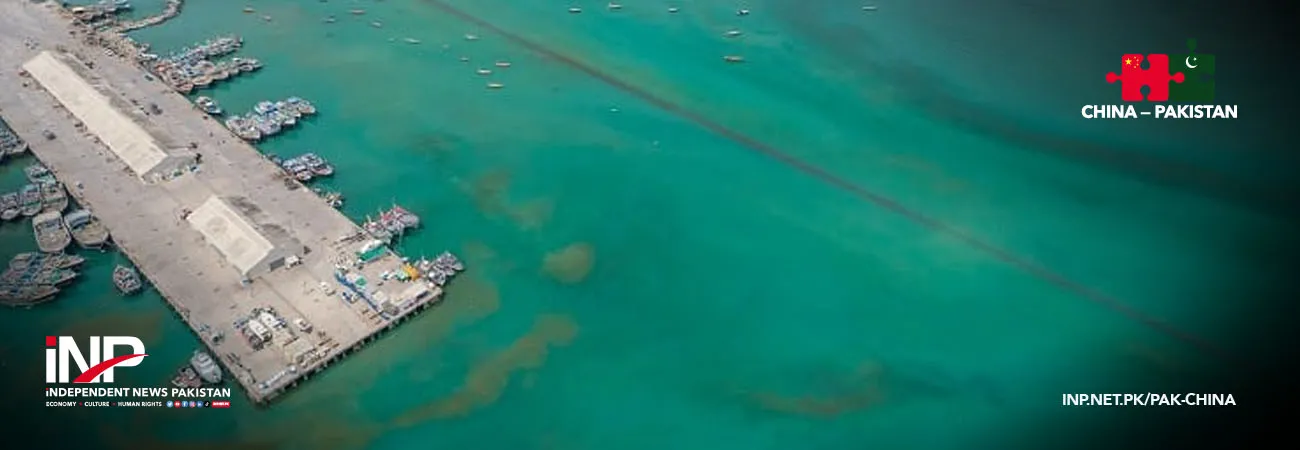
Gwadar emerges as a future regional hub for trade and logistics: Economic SurveyBreaking
June 12, 2026
Pakistan’s Economic Survey 2025-26, unveiled, highlighted Gwadar’s growing importance in the country’s economic and connectivity plans, describing the port city as a future regional hub for trade, logistics and transshipment.
The survey said the Eastbay Expressway has “significantly improved connectivity to Gwadar Port by providing a dedicated, signal-free corridor linking the port, Free Zones, and the Makran Coastal Highway, resulting in reduced congestion, lower transport costs, and more reliable cargo movement.”
The government also reported progress on plans to connect the New Gwadar International Airport with Gwadar Port and the Free Zones through a second phase of infrastructure development that would enable “integrated sea-air logistics, " Gwadar Pro reported.
The survey described Gwadar Port as occupying “a strategically significant position at the mouth of the Persian Gulf, just outside the Strait of Hormuz and along one of the world’s busiest maritime trade corridors.”
It added that development under the China-Pakistan Economic Corridor (CPEC) has “enhanced Gwadar’s importance as a future hub for trade, logistics, and transshipment activities, with the potential to strengthen regional connectivity and attract foreign investment.”
According to the survey, “Gwadar Port is steadily emerging as a strategic pillar of Pakistan’s maritime economy and regional trade architecture”.
The report said development activities continued during the fiscal year to “enhance its commercial viability and operational capacity.”
It noted that China Overseas Port Holding Company completed master planning and feasibility studies for the main Free Zone spanning 2,281 acres, while construction work on several industrial units has begun.
The survey said port operations were also gaining momentum, with international shipping companies including COSCO and Sino-Trans maintaining regular services.
“These developments are expected to further support Gwadar Port’s emergence as a regional trade, logistics, and transshipment hub,” it said.
On energy, the survey disclosed that the Prime Minister of Pakistan has “granted in-principle approval for the processing of a 40 MW power project in the Gwadar region”.
To tackle chronic utility shortages, the report said the Power Division and the Private Power and Infrastructure Board carried out a preliminary assessment focused on “solarizing 24 pumping stations and one water desalination plant.”
The proposed solution includes “9.7 MW of solar PV systems coupled with 18.26 MWh of BESS” and is expected to generate annual savings of Rs987 million.
The survey said, “This configuration is expected to generate annual savings of Rs 987 million, with an estimated payback period of 2.7 years.”
The Economic Survey presented the developments as part of broader efforts to improve connectivity, infrastructure, energy security and commercial activity in Gwadar as Pakistan seeks to strengthen the port's role in regional trade networks.
Credit: Independent News Pakistan (INP) — Pak-China
Related News