


INP-WealthPk

Entry of new players in Pakistan’s automobile sector promises new technology, lower prices
March 06, 2026
By Muhammad Luqman
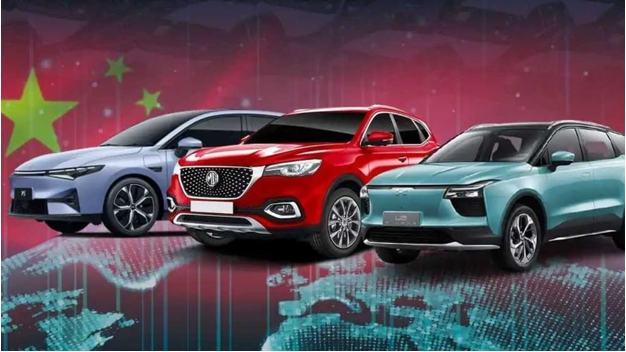
The arrival of Chinese automobile manufacturing and assembling companies has reshaped Pakistan’s auto market, which was long dominated by three Japanese companies.
“The new players have increased consumer choice, introduced new technologies, and intensified price competition for the existing manufacturers,” said Mian Muhammad Ali Hameed, Chief Executive Officer of Great Wall Motors Pakistan.
Talking to Wealth Pakistan, he said that major Chinese brands currently operating in Pakistan include Changan Automobile, Great Wall Motors, MG, Chery, Omoda & Jaecoo, BAIC, FAW Group, and Jetour. “The world-leading electric vehicle manufacturer, BYD, is the latest addition,” Hameed said.
In Pakistan, there are around 20 major four-wheeler manufacturing and assembling companies. Of these, only five — three Japanese (Honda, Suzuki, and Toyota) and two Korean (Hyundai and Kia) — are non-Chinese brands.
Despite the entry of non-Japanese companies, the combined share of Japanese brands — Suzuki, Toyota, and Honda — still accounts for well over 70% of passenger vehicle sales, with Suzuki alone holding around 47% of the market.
The share of Chinese brands is estimated at 20% of Pakistan’s passenger vehicle market, with a strong presence in SUVs and “new energy vehicles” (hybrids and EVs), especially Range-Extended Electric Vehicles (REEVs).
Mr Hameed said that Japanese original equipment manufacturers (OEMs) remain dominant in legacy segments, while Chinese OEMs are rapidly scaling up in higher-end and electric vehicle segments.
He added that due to the introduction of new technologies, demand for once most sought-after models such as the Toyota Corolla and Honda Civic has declined drastically, as alternatives are more technologically advanced and appealing.
Regarding the two-wheeler sector, Hameed said that with the introduction of new motorcycle models about two decades ago, Japanese companies lost around 35% of their share in the two-wheeler market. “However, companies producing copycat versions of the Japanese CD-70 model failed to satisfy consumers in the long term. The Japanese company Honda is once again enjoying about a 90% share of Pakistan’s motorcycle market.”
The expansion of the automobile sector in Pakistan has also generated new opportunities for vendors.
“New demand for tooling, plastics, electronics, and battery-related parts is emerging, though it is still at an early stage,” said Syed Nabeel Hashmi, former chairman of Pakistan Association of Automotive Parts & Accessories Manufacturers.
Talking to Wealth Pakistan, he said that Chinese players are investing in local assembly plants and completely knocked down (CKD) operations, adding capacity and diversifying the vendor base.
However, he regretted that local vendors are not fully benefiting from these opportunities due to limited push from the federal government for localisation.
“We are expecting the revival of the Malaysian premier car brand, Proton, soon. However, this may be in the internal combustion engine (ICE) or hybrid segment,” Hashmi said.
He added that government policies such as the National Electric Vehicle Policy, the Auto Industry Development Programme, tax cuts on electric vehicles and chargers, and incentives for localisation — especially for new entrants — would go a long way in promoting every segment of the auto industry.
Credit: INP-WealthPk
Related Articles